
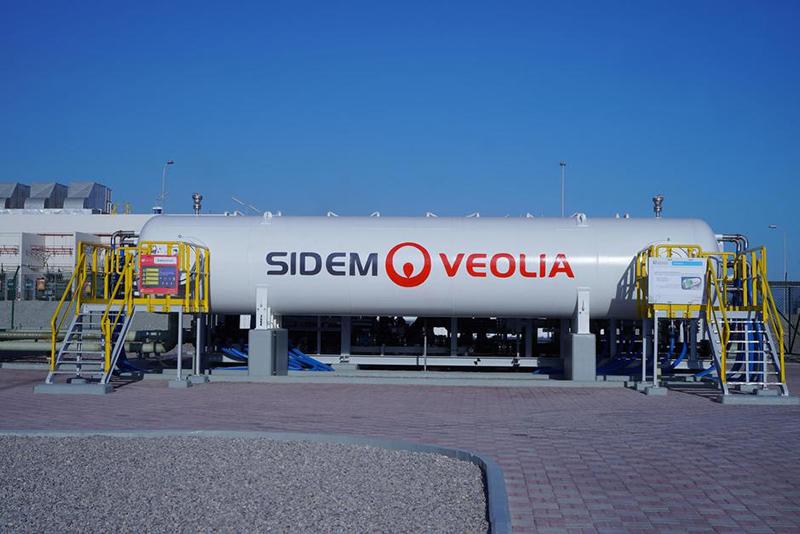
Veolia Water Technologies, has announced the Asia Pacific launch of the Barrel an integrated plug-and-play reverse osmosis (RO) technology. The Barrel will be showcased at CleanEnviro Summit Singapore (18-21 April) and OzWater 2022 trade exhibition in Brisbane, Australia (10-12 May).
With increasing demand for fresh water and rising concerns over scarcity in the region, the Barrel meets the challenges and expectations of the desalination market while producing fresh water complying with all water quality standards. It is also suitable for wastewater reuse and low-pressure RO applications. The Barrel will empower users with an economically viable and sustainable source of fresh water.
The Barrel was selected as a key technology for the first experiment in Europe in wastewater treatment for the supply of drinking water through the Jourdain programme, in France’s Vendee region. The technology has also been in use at the Oman Sur desalination plant since 2019.
About the technology
The Barrel is a multi RO element vessel that is designed to be a plug-and-play system. The carbon steel pressure vessel is manufactured and tested off-site, and is delivered as a single unit, so installation on-site can be fast-tracked and project schedules shortened. In addition, the modular design of the Barrel makes it highly scalable, offering varying capacities from 400 m3/day to 50,000 m3/day per unit. It can also be used in place of existing RO membranes and nanofiltration skids for a more economically viable, sustainable, and innovative alternative.
Compact and suitable for outdoor installations, the Barrel offers a footprint reduction of up to 25% and does not require a controlled environment. The sustainable solution also provides a reduction in electrical consumption in the range of 0.05 kWh/m3 of fresh water produced.
Beyond sustainability, the unique design of the Barrel also significantly reduces the number of high-pressure piping connections down to just two — the seawater inlet and the brine outlet. This design feature makes it safer for operators and minimizes risks on-site during the maintenance and operation phases. Corrosion is less likely to occur as seawater leakage sources found on the multiple high-pressure connections of traditional RO skids are reduced.
The Barrel also has a built-in digitalisation system with smart connectors providing real-time status updates on each membrane’s condition. In fact, their performance can be monitored automatically and accessed remotely — helping operators to make better decisions, whether to shut down, rotate, or replace membranes.