
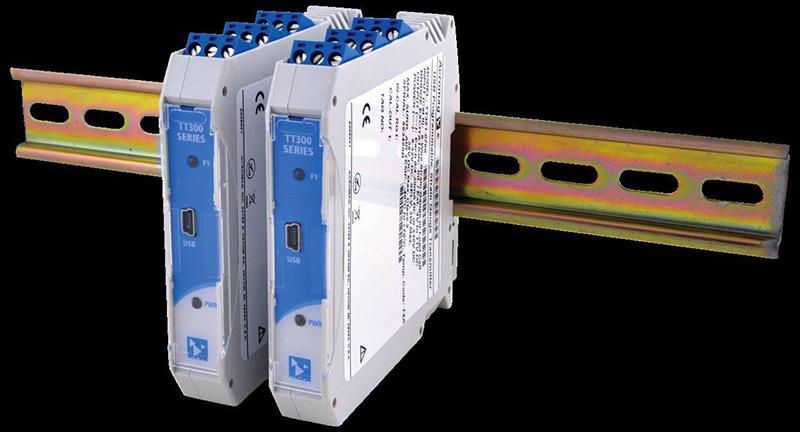
Acromag’s TT351 model is a space-saving four-wire transmitter that converts a four or six wire strain gauge bridge or load cell or milliVolt sensor signal to an isolated voltage or current output signal. An optional DIN rail bus can deliver primary or redundant power to multiple units.
Setup and calibration are fast and easy with a convenient USB connection to your PC and Acromag’s Windows configuration software.
The transmitter’s input circuit allows true 6-wire bridge measurement and includes an adjustable bridge excitation supply (4 to 11V DC) with a remote sense feature. Sense wires ensure the programmed excitation voltage is measured at the sensor and enable lead-wire compensation. The differential input performs true ratiometric conversions for extremely stable measurements that remain accurate over time and temperature.
Versatility:
Advanced signal processing capabilities, variable range input, and convenient USB programming make this instrument very versatile for strain/load measurement. One model can process strain gauge, load cell, and milliVolt input signals from 1-10mV/V. Initial bridge offsets or forces can be automatically removed with null compensation, tare, and zero-balance bridge functions. An internal half-bridge can perform half- and quarter-bridge completion with precision resistor pairs or bias a floating milliVolt input signal. A custom input signal linearised function supports up to 25 user-defined signal breakpoints. Flexible scaling is independently adjustable for input and output. To suppress noise effects, users can set a variable digital input filter level or average several samples. Shunt calibration tools with a simulation calculator enable rescaling of the transmitter’s indicated strain by modifying software gain and/or the instrument gauge factor. To test or verify operation, a software diagnostics screen polls the unit, then displays measured and computed values.
These transmitters can withstand harsh industrial environments and operate reliably across a wide temperature range with very low drift. They feature RFI, EMI, ESD, EFT, and surge protection plus low radiated emissions.
For Further information, please contact:
Metromatics Pty Ltd