
Author: Dr Felix Wei, Technology Analyst at IDTechEx
The global chemicals industry produces well over one billion metric tons of chemicals every year, yet only a small fraction originates from biomanufacturing. As governments and manufacturers pursue decarbonization, investment in bio-based chemicals continues to grow. However, one of the most common misconceptions remains that a bio-based chemical is automatically biomanufactured. In reality, the feedstock and the manufacturing process are separate considerations, and understanding this distinction is essential when evaluating technologies, sustainability claims, and commercial opportunities.
Industrial biomanufacturing is becoming an increasingly important part of the wider bioeconomy, representing a key method for producing bio-based chemicals. The latest IDTechEx report, "Industrial Biomanufacturing 2027-2037: Technologies, Markets, Players, Forecasts", examines this manufacturing pathway in detail, covering more than 35 commercially relevant biomanufactured molecules, technology readiness, production economics and the companies developing next-generation manufacturing platforms. Understanding how different chemicals are produced is fundamental to assessing where industrial biomanufacturing will create the greatest impact.
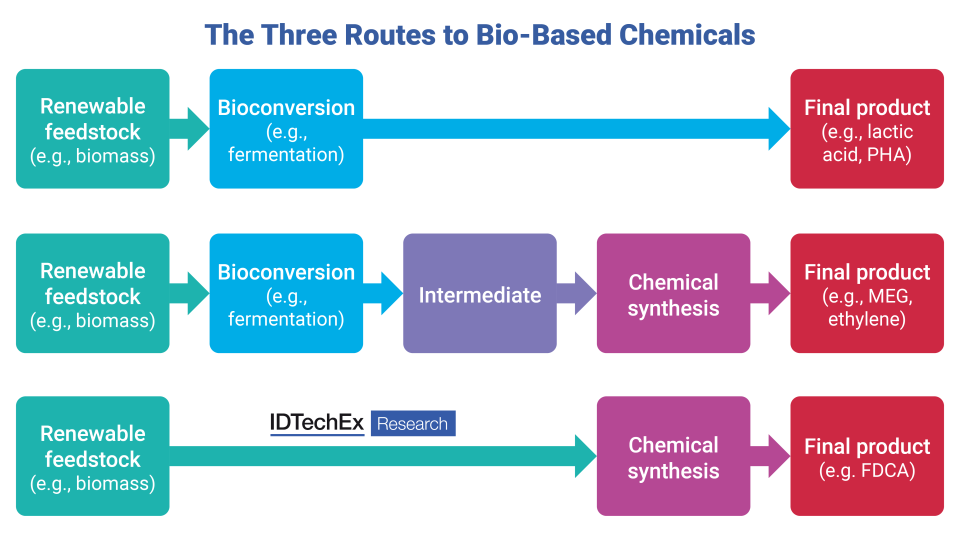
Direct biomanufacturing
The first route is direct biomanufacturing, where renewable biomass is converted into a target chemical through biological processes such as microbial fermentation or enzymatic catalysis. Chemicals such as lactic acid and PHAs can be produced through this route. In many cases, advances in synthetic biology and metabolic engineering have enabled microorganisms to produce molecules that either occur naturally or have been engineered into new biosynthetic pathways. A notable example is 1,4-butanediol (1,4-BDO), a molecule that does not naturally occur in living organisms. Commercial production became possible only after researchers engineered E. coli with an entirely synthetic metabolic pathway, demonstrating how industrial biomanufacturing can expand beyond nature's existing chemistry.
Biomanufacturing with chemical synthesis
The second route combines biomanufacturing with conventional chemical synthesis. Rather than producing the final chemical directly, fermentation first generates an intermediate, which is subsequently converted through additional chemical processes. Bio-based monoethylene glycol (MEG) illustrates this well. Biomass-derived sugars are fermented to produce bioethanol, which is dehydrated to ethylene, catalytically converted to ethylene oxide, and finally hydrolysed to MEG. This hybrid approach often reduces technical risk by integrating biological production with well-established chemical infrastructure, making it an attractive route for commercial deployment.
Direct chemical synthesis
The third route bypasses biology almost entirely after the biomass is harvested. Renewable feedstocks such as sugars or lignocellulosic biomass undergo direct chemical synthesis into platform chemicals through catalytic or thermochemical processes. Molecules including levulinic acid, furandicarboxylic acid (FDCA) and some emerging routes to adipic acid are produced using this approach. While these chemicals are bio-based because their carbon originates from biomass, they are not biomanufactured.
Implications for bioplastics
These different routes become particularly relevant when examining bio-based polymers. Materials such as PET, PBT, PBS, PTT, PEF and bio-based polyamides often contain monomers originating from multiple manufacturing pathways. PET provides perhaps the clearest example. Commercial bio-based PET is typically only partially bio-based because the MEG monomer can be produced from renewable biomass, whereas the terephthalic acid monomer generally remains fossil-derived. As a result, two monomers within the same polymer may originate from entirely different production routes despite both ultimately contributing to a bio-based product. Furthermore, although bio-based PET offers performance equivalent to conventional PET, it must also compete against recycled PET, which has become a mature and economically attractive material.
The same considerations extend to polymers such as PBT and PBS. Both rely on 1,4-BDO, while PBS additionally depends on succinic acid as a key precursor. Biomanufactured succinic acid attracted significant commercial interest because it is a natural intermediate of the tricarboxylic acid (TCA) cycle and can be produced efficiently through engineered microorganisms. However, commercial success has been constrained by production costs relative to fossil-derived alternatives. Likewise, bio-based 1,4-BDO has demonstrated remarkable technical achievements through synthetic biology but continues to represent only a small proportion of global production. These examples illustrate that technological feasibility alone is insufficient; manufacturing economics remain equally important in determining commercial adoption.
Outlook
Looking ahead, the future of industrial biomanufacturing will likely be shaped not by replacing every petrochemical process, but by identifying where biology provides genuine competitive advantages. Hybrid manufacturing routes that combine fermentation with efficient chemical synthesis may offer the most practical balance between sustainability, scalability and cost. Meanwhile, continued advances in strain engineering, process optimization, and next generation feedstocks will expand the range of molecules that can be produced biologically. Companies evaluating investment opportunities will increasingly need to understand not only whether a chemical is bio-based, but precisely how it is manufactured. IDTechEx's Industrial Biomanufacturing 2027-2037 report provides detailed analysis of these production pathways, technology readiness, company activity and market opportunities, helping stakeholders identify where industrial biomanufacturing can deliver both environmental benefits and long-term commercial value.
For more details on industrial biomanufacturing market drivers, technology trends, company landscape, and market forecast, see the IDTechEx market report, "Industrial Biomanufacturing 2027-2037: Technologies, Forecasts, Markets, Players". More information on this report, including downloadable sample pages, can be found at www.IDTechEx.com/IndustrialBiotech. For more information on IDTechEx's other reports and market intelligence offerings, including bioplastics and biofuels, please visit www.IDTechEx.com/Research