
Construction on the significant AD plant in the south of the country began in 2025, overseen by a leading EPC contractor. Now fully operational the plant will generate 58 GWh of biomethane which will be injected directly into the gas grid – providing enough energy for 11,000 homes.
Because the plant uses a mixture of agricultural and livestock waste, including whey, olive pomace, chicken manure and pig slurry, the digestate produced by the anaerobic digestion process must be pasteurised to comply with European animal by-products rules – Regulation (EC) No 1069/2009 – before it can be used as a valuable agricultural fertiliser.
The use of this digestate is a key element of fulfilling Spain’s ambitions to create circular economy projects which actively boost the sustainability of rural areas. In this case, not only does the project help local farmers manage their organic wastes, but also provides a low carbon alternative to synthetic fertilisers.
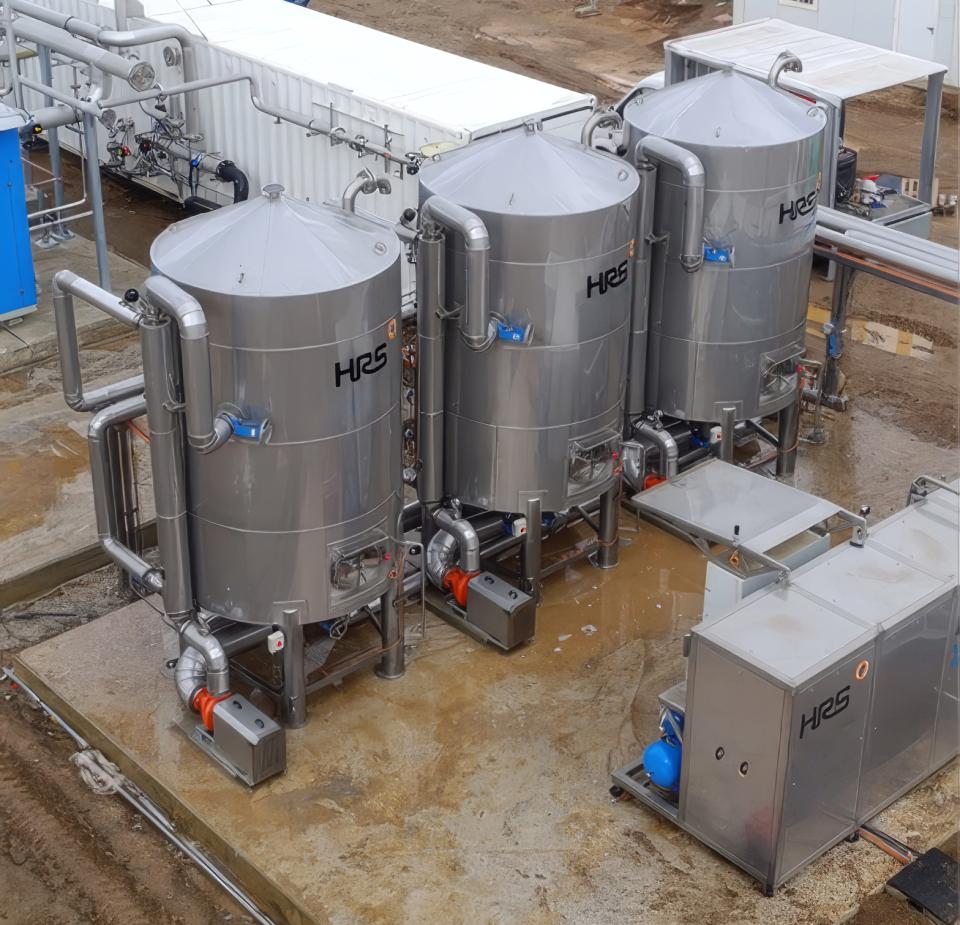
After investigating the different options, the client selected an HRS Digestate Pasteurisation System (DPS) capable of pasteurising 200 tonnes of digestate each day. The HRS DPS has already been successfully installed at biogas plants around the world, preventing the spread of potential pathogens and meeting local legal and quality requirements.
The standard 3-tank DPS provides continuous pasteurisation, with one tank being pasteurised while one is filling, and another being emptied. The HRS pasteuriser uses a corrugated double tube heat exchanger to heat the digestate to 75°C (above the required pasteurisation temperature). This allows for variation in the sludge consistency and its incoming temperature, making sure that the digestate is always properly pasteurised. The tanks can also be used individually, for example to allow for routine maintenance.
In this situation, the HRS DPS recovers as much as 50% of the total thermal energy as heat from the hot pasteurised digestate is passed to the incoming cold digestate, resulting in savings of 1.75 million kWh of thermal energy (or 375t CO2 emission per year). HRS supplied the client with a complete turnkey solution comprising heat exchangers, positive displacement pumps, and holding tanks, together with instrumentation, valves, piping and a control system.
Antonio Guillermo Jara Ponce, Global Sales Manager, Europe at HRS Heat Exchangers, comments: “The client chose the HRS Digestate Pasteurisation System after reviewing the performance of other installed systems at AD plants around the world, and the energy savings from energy recovery that the DPS offers compared to other pasteurisation options.
“In 2024 Spain had 12 biomethane sites, rising to 25 in 2025, and by the end of 2026 we will have 46 operation biomethane facilities. The trajectory of development continues to double each year, with as many as 90 projects anticipated to come online in 2027. This represents significant biogas and waste treatment capacity, and it is important that the most efficient solutions are chosen, not only for the AD process itself, but also for digestate management and pasteurisation.”