
It might not have the dangerous fauna and flora of Australia, but the Shaky Isles aren’t without their hazards. Notorious for slips, floods, and erosion due to its steep terrain, fractured geology, and occasional severe weather, New Zealanders routinely wake to the havoc of slips across hillsides and transport corridors.
Meanwhile, the relentless ocean works away at vulnerable shorelines, and rivers prone to flooding wash millions of tons of sediments into the sea, destabilising bridges and other essential infrastructure.
But from the same capricious Mother Nature comes the inspiration for a cost-effective solution that stops erosion in its tracks: the hexagon is central to every beehive. “The hexagon is nature’s supershape for a reason. It is a strong, versatile natural building block. Bees use it for honeycombs, and it emerges in structures from snowflakes to basalt columns,” points out HEX-LOC Business Development Manager Rachael Mackman.
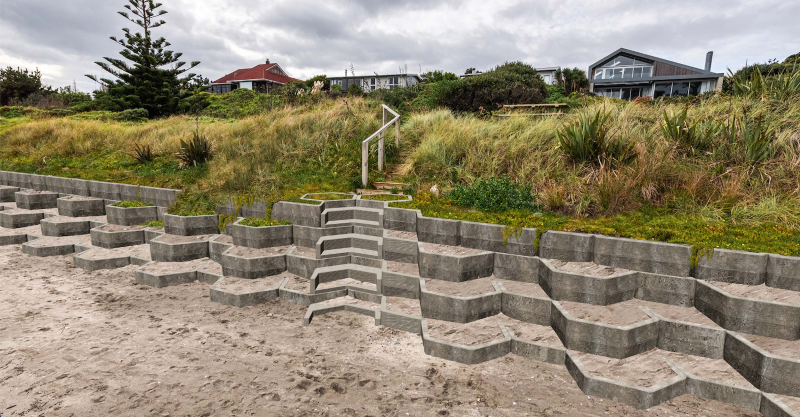
HEX-LOC and EcoReef address inland slope instability and coastal erosion, according to Mackman, utilising a clever modular hexagonal block. The blocks connect horizontally and vertically, forming an interlocking honeycomb structure that creates a stable, adaptable mass capable of managing erosion on slopes, riverbanks, coastal areas, and alongside roads.
“Bees have shown us that the basic honeycomb is incredibly versatile,” Mackman notes. “Our engineers have harnessed that inspiration, delivering an abatable stabilisation solution that works in almost any place susceptible to washaways.”
The design combines strength with flexibility, making it suitable for diverse applications in civil engineering, coastal protection, and landscape management.
Mackman says other techniques for arresting constantly shifting soft soils have been both expensive and inflexible. “For example, gabions are cumbersome, time-consuming, and require custom installation with a high degree of manual labour, and require rock, which may or may not be available near site,” she explains.
Traditional piling methods often come with significant costs, especially in remote or difficult-to-access locations. While vegetative solutions provide natural and effective protection, they require time to establish.
By contrast, HEX-LOC provides a flexible solution that adapts to many needs. Each block is designed to interlock seamlessly, and when combined and stacked in tens or hundreds, they form a robust, self-supporting structure. Their hexagonal frame is intentional: it simplifies handling and allows any onsite fill to be used, significantly reducing transport costs. “The lattice structure is part of the genius,” adds Mackman.
“And that also provides the substrate for vegetation to take hold, adding to the ecosystem and protecting vegetation from subsequent erosion events.”
Each stackable cell is substantial in scale, measuring 1400mm x 1585mm and weighing 620kg, increasing by more than a ton once filled. Thanks to its innovative design, installation is rapid and efficient, with blocks interlocking seamlessly above and below. Contractors consistently report ease of use, noting that no additional equipment is required to achieve secure placement.
Mackman sends kudos to the bees and the engineers behind the system. “It’s pretty clever as it directly targets one of the biggest cost centres associated with erosion control: labour. When erosion control requires specialised skills, fixing problems takes longer, and the problem worsens, making remediation yet more expensive. We’ve created a high-tech solution resting on a low-tech building block. Installation is fast, simple and easy, which means more slips and unstable slopes can be repaired, for less money.”
It's a ‘Kiwi solution for a Kiwi problem’, adds Mackman. “The ‘Shaky Isles’ with our constant slew of slips isn’t about to change. What can and must is how we deal with them,” she concludes.