
The handling of aggressive chemicals leads to hundreds of deaths in the USA every year. Yet many workers are still filling hazardous substances such as sodium hypochlorite, acids, and alkalis manually, warns Markus Seitenberg, managing director of industrial pump specialist Lutz Pumps North America. To improve safety, a new pump tube made of chlorinated polyvinyl chloride (CPVC) aims to reduce the risk of spills and injuries.
Aggressive chemicals are everywhere in industry. For the workers, these critical substances often prove dangerous, especially when transferring sodium hypochlorite from large canisters or drums without pumps or protective covers. Results from the US Bureau of Labor Statistics show that this process not only causes frequent skin burns, eye injuries, and respiratory damage, but also fatalities[1]. In 2023, 820 people died in the USA due to exposure to harmful substances and environments. This accounts for about 15% of all fatal work accidents, the total of which is 5,283. “Some of these accidents occur when manually refilling aggressive chemicals. This is why it is so important to provide workers with the suitable technology for safe handling,” says Markus Seitenberg. “For this reason, we developed a new pump tube that enables the safe transfer of critical media from canisters and drums.” The pump unit is available effective immediately.
Controlled conveying instead of pouring
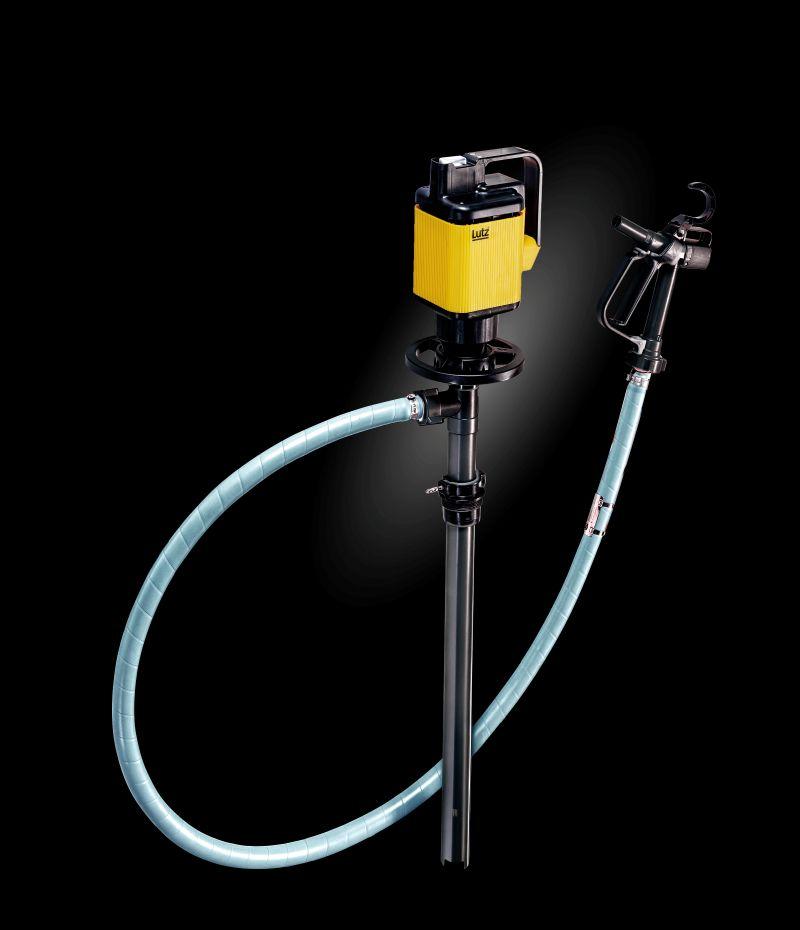
The pump tube is designed as a vertical immersion pump. With an immersion depth of 39 inches, it can be inserted directly into drums and canisters. An electrically or pneumatically operated motor can be attached on top. The motor drives a radial impeller via a shaft, which guides the medium into a conveying line through centrifugal force. This enables the safe conveying of up to 25 gal/min. (95 l/min.) without any risk of spillage. An optional dispensing nozzle and flow meter enable targeted dispensing.
The new CPVC pump tube aims to reduce the risk of spills and injuries
The pump tube is made of chlorinated polyvinyl chloride (CPVC). This makes it resistant to chemicals and ideal for transporting not only sodium hypochlorite, but also alkalis (including caustic soda and potash lye), precipitating and flocculating agents (including iron or aluminium salts), and cleaning and rinsing chemicals. Additional safety is provided by the fact that the design does not use any seals on parts that come into contact with the medium. This reduces the risk of leaks.
Improved cost effectiveness compared to traditional PVDF pump tubes
While PVDF versions offer similar chemical resistance, the CPVC model is significantly more economical - often 20-30% lower in price based on market comparisons - without compromising performance for suitable media. This makes it an ideal choice for budget-conscious operations that demand durability and safety. "The CPVC drum pump represents our commitment to delivering high-quality, affordable solutions that prioritize employee safety and operational efficiency," said Markus Seitenberg, President and General Manager of Lutz Pumps Inc. "By offering a cost-effective alternative to PVDF without sacrificing reliability, we're empowering industries to handle corrosive chemicals more securely and economically."