
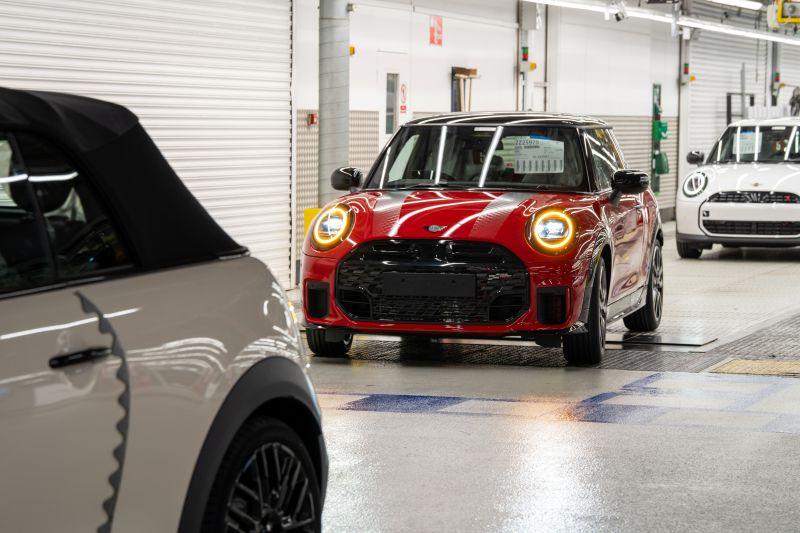
The BMW Group has reached another milestone on the road to digital and intelligently connected production: One million vehicles have now been moved and guided at BMW Group plants using “Automated Driving In-Plant” (AFW) technology. At Mini Plant Oxford alone, this amounts to more than 53,000 automated vehicle movements in the past year. AFW optimises the production process and delivers significant efficiency gains for logistics.
From pilot project to globally scalable standard application
Mini Plant Oxford is the fourth BMW Group plant after Dingolfing, Leipzig and Regensburg to use this technology. Since the pilot was launched in Dingolfing in 2022, AFW has progressed from an innovative technology trial to a well-established, scalable standard application that will be rolled out in stages across the BMW Group's global production network. An average of around 3,500 automated vehicle movements currently take place every day across the network.
Using AFW, vehicles can respond dynamically to their surroundings. This not only includes people, but also other vehicles, driverless transport vehicles, logistics traffic and temporary obstacles.
Mini Plant Oxford is the first BMW Group location to connect automated guided vehicles directly with existing control systems. The AFW system precisely positions the vehicle next to a lifting device, where a specific operation is carried out. Automated interaction between vehicle and equipment is enabled by a cloud-based solution. This marks the next logical step in the integration and scaling of automated vehicle movements in the production environment.
Oxford provides a unique setting for this technology. The plant can look back on more than 100 years of industrial history. Here, state-of-the-art software, sensors and cloud technologies meet a production environment that has been part of British automotive history for generations.
Technology leadership through intelligent connectivity
AFW moves new vehicles without a driver in defined production and logistics areas. The technology is based on an intelligent combination of external sensors, cloud architecture and advanced motion planning software. Along the route, LiDAR sensors constantly capture the environment, enabling secure vehicle navigation in real time. Artificial intelligence supports the continuous development, simulation and operation of this technology. At its Dingolfing plant, the BMW Group operates the largest LiDAR infrastructure in Europe. This forms the basis for automated driving manoeuvres and, at the same time, provides valuable insights for further deployment within the production network.
Outlook: Further expansion of AFW across the BMW Group network
The BMW Group is continuing the systematic AFW rollout across its production network. Within the next year, the technology will also be introduced at BMW Group Plant Spartanburg. In this way, the global application will continue to expand, laying the foundation for further applications in the production environment.
The Automated Driving In-Plant technology was developed in close collaboration with Swiss company Embotech and further scaled through several development phases. Following a multi-year partnership between Embotech and the BMW Startup Garage, which identifies and supports innovative technologies in the early stages, the company's own venture capital fund, BMW i Ventures, acquired a financial interest in Embotech in December 2024.
Frequently Asked Questions about AFW:
How does Automated Driving In-Plant work?
AFW combines external sensors, cloud architecture and motion planning software. Along the route, LiDAR sensors continuously capture the environment, enabling vehicles to navigate in real time.
What makes AFW unique?
A key feature of AFW is its use of offboard sensors: The sensors required for automated driving are installed in the plant infrastructure. This allows vehicles to be moved automatically regardless of their individual equipment specification. At the same time, the offboard sensors enable reliable monitoring of larger areas and narrow passages, supporting an efficient process flow. AFW is also CE-certified for safe use in the production environment. This creates an important foundation for scaling the technology to additional areas and further BMW Group plants.
What is the significance of the LiDAR infrastructure for AFW?
As a central component of AFW, the LiDAR infrastructure forms the basis for automated driving manoeuvres within the plant. Along the route, LiDAR sensors continuously capture the environment, enabling the safe navigation of vehicles. At BMW Group Plant Dingolfing, the BMW Group currently operates the largest LiDAR infrastructure in Europe, providing valuable insights for the further deployment of the technology across the production network.