
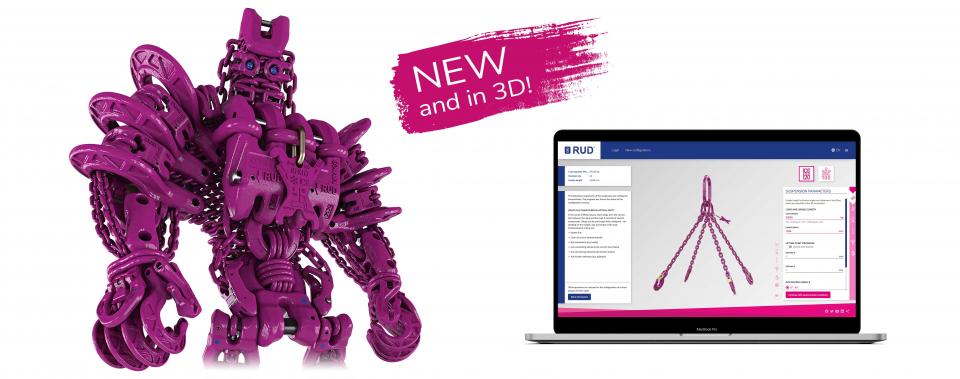
RUD, a German supplier of sling and lashing technology, presented a new and innovative sling configurator. Thanks to its 3D view, chain slings can be configured online easily, quickly and safely. In addition, during every configuration step, the web application provides background information and practical hints on lifting and moving loads as well as on RUD products. The configurator can be used free of charge at www.lifting-planner.com.
Configuring lifting chains for specific applications can be a time-consuming and complex task. In addition, from a safety and economic perspective, there are multiple factors that have to be taken into account, meaning that you can soon lose sight of things. These include environmental influences such as the temperature in the application area or the impact loads' influence. Thanks to its new 3D sling configurator, RUD promises a simple web application for configuring chain slings.
"Configuring slings correctly is crucial. If certain lifting parameters are not taken into account, or when wrong loads are determined, this can have dramatic consequences in the subsequent application," Jürgen Grubmüller, Marketing Manager for slings and lashing equipment at RUD, explains. "With our new RUD sling configurator, for example, we are giving buyers, designers, plant managers or users a comprehensive tool to configure the perfect chain sling for specific applications."
Including useful additional information and practical knowledge
With more than 140 years of company history, RUD is regarded as an international expert in sling and lifting technology. The global market leader would now like to pass on its expert knowledge in the new sling configurator. This guides the user through the individual levels of configuration, step by step. In an information block, the user can obtain important information and hints on the chain sling's design. "For us, it was important to ensure that even those who are less familiar with the subject can find their way around the individual suspension components' functions within a very short time; knowing what is important in the configuration and what they have to pay attention to," Jürgen Grubmüller continues.
Just six steps to the finished chain sling
You only need six steps to design the finished chain sling at RUD: First, the user enters suspension parameters such as payload and length before then selecting possible environmental influences by a mouse click. Once this is completed, suspension elements, shortening elements and intermediate components have to be added. In the last step, you have to click on the requested final component (F.e. a hook). Thanks to the 3D view, the user can view the current status of his configured suspension at any time in a photo-realistic 360° model and rotate it in all directions, as needed.
Create a parts list automatically and send an enquiry
If the user has registered free of charge in advance, the finished configuration can also be saved, shared and discussed with partners. For example, the configurator also automatically creates a parts list for the created hanger. "The user has a graphic of his configured hanger directly at hand and can send us an enquiry or download a PDF of the configuration," Jürgen Grubmüller explains. "Nothing could be simpler."