
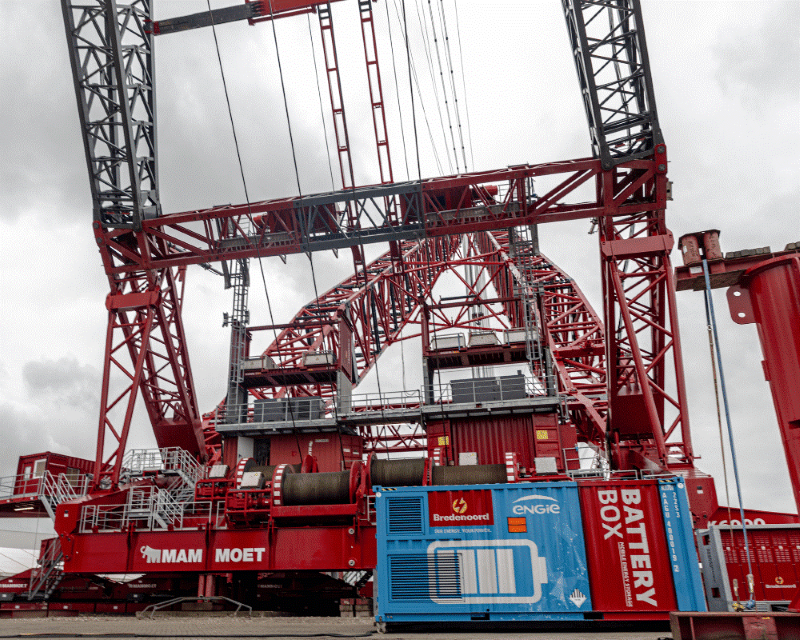
Mammoet’s SK6000 - the world’s strongest land-based crane – has been tested for fully electric operation. It now offers zero-emission capability to projects taking place anywhere in the world.
Through this innovation, Mammoet is demonstrating its commitment to helping customers reduce the emissions profile of large projects. The technology also reduces the noise generated by crane operations, resulting in a better work environment where communication is easier.
In turn, large projects are made safer, cleaner and easier to finance.
The SK6000 can now operate directly from grid power – or, at sites without power network access or with supply stability issues - via batteries or hydrogen generators.
Testing was carried out using two 600kWh Battery Boxes from power supply specialist Bredenoord, connected in series to deliver 1,200kWh; around the same output as 20 electric cars.
Connection took a day shift, in parallel with test weight reconfiguration activity. This proves that the use of batteries has minimal impact on site operations.
Battery packs capable of operating the SK6000 are becoming widely available, in standard 20ft shipping container form factors, which can easily be mobilized to and from site.
By plugging into a medium voltage network – commonly available in heavy industry – the SK operates directly from the grid. At port facilities, so-called ‘shore power’ connections, typically used to prevent cargo vessels idling at port, are capable of powering the crane.
Battery functionality offers a further option, with the additional benefit of being chargeable from lower power networks. The significant periods of time between individual ring crane lifts allow the chance for battery packs to recharge.
Hydrogen generators can be used where neither grid power nor battery power is an option, for example at remote sites without significant infrastructure.
With SK6000 electric functionality confirmed, Mammoet can now offer a fully zero-emission, low noise marshalling service to customers in the offshore wind sector.
Oil and gas projects benefit from complete elimination of carbon impact during the heaviest lifting scopes, at the same time as realizing the largest possible economies of scale from modular construction methodologies.
In the nuclear sector, reduced noise levels will enhance safety levels at complex new build sites while allowing projects to deliver low-carbon energy in a sustainable way.