
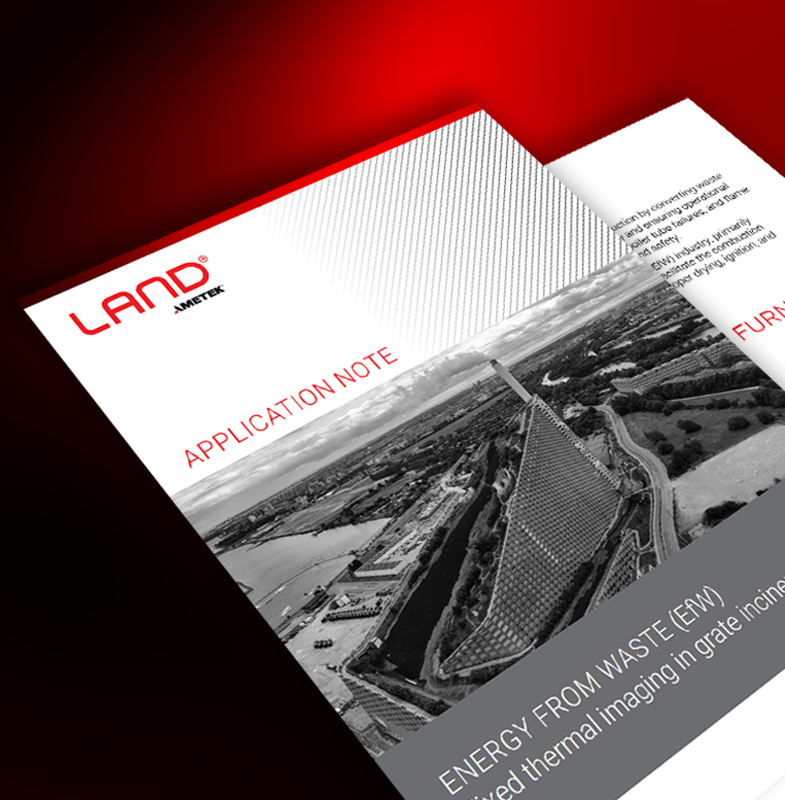
Land highlights how its fixed thermal imaging solutions are helping improve combustion efficiency and reliability in grate incinerators in a new application note that includes example images and data from real installations.
Energy from Waste (EfW) plants are already a crucial part of many countries’ energy mix, but operators face significant challenges due to the heterogeneous nature of the fuel, including slag build-up, boiler tube failures and difficulty optimising the combustion reaction. These issues affect safety, efficiency, reliability and ultimately the profitability and viability of the plant.
Land has released a new application note which details the process challenges of these issues and the solutions to meet them.
Mid-wavelength thermal imaging penetrates opaque flue gases to provide real-time visualisation of the grate and boiler sidewalls, which enables operators to monitor slag build-up, optimise drying, burning and burnout zone temperatures, and predictively plan maintenance, outages and cleaning schedules to reduce downtime and improve safety.
The MWIR-b-640 is the Land solution. This mid-wavelength radiometric infrared borescope imaging camera delivers a clear image of the grate and wall temperatures even in smoky and dusty furnace atmospheres and is engineered for tough, high temperature applications: for example, the replaceable lens window on the tip of the borescope is replaceable in the field in case of damage in turbulent environments. LAND’s intuitive ImagePro software is configured to provide continuous temperature values from the grate and alarms on small tube leaks and temperature variations early, leading to process optimisation.
James Cross, Head of Industry Management at land said: “We knew EfW was a potential application for Land’s portfolio of pyrometers and thermal imagers, but we didn’t realise just how much interest the industry would show. Our CDB pyrometer is installed in the roof of many grate furnaces, but introducing thermal imaging has been a really interesting experience: operators are typically immediately impressed with the thermal image clarity and then start digging into the data to identify grate temperatures, slag build up and potential leaks”.
For more information download the application note here.