

A Government and industry initiative piloted in Waikato, described by employers as “recruitment speed dating,” is set to cut the costs of hiring staff for hundreds of businesses around the country after delivering one of the highest completion and employment rates seen in the manufacturing sector.
Industry experts say the programme is also helping to break down long-standing stereotypes about New Zealand’s productive sectors by giving learners firsthand exposure to modern, technology-driven workplaces that challenge outdated assumptions about manufacturing.
The Earn as You Learn programme was launched earlier this year as a collaboration between Waikato manufacturers, Advancing Manufacturing Aotearoa, WINTEC, the Waikato Engineering Careers Association and Workforce Development Council Hanga-Aro-Rau.
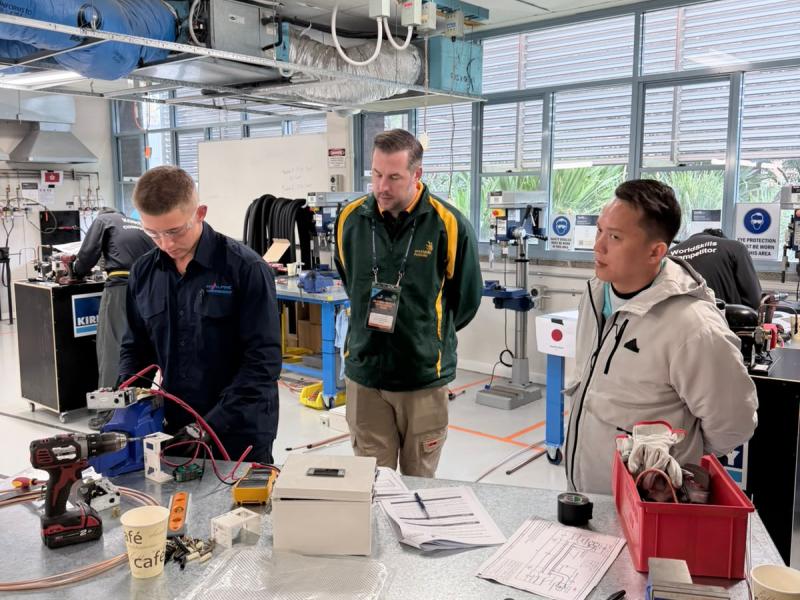
The 30-week model combines paid workplace rotations with classroom study, giving students two days a week at WINTEC’s Rotokauri Campus and three days in hands-on roles across some of the region’s most advanced manufacturing firms. Over the course of the programme, students rotate through three employers, gaining exposure to different production environments and technologies.
The initiative was developed to address New Zealand’s worsening manufacturing skills shortage at a time when the manufacturing, engineering and logistics sectors are facing a projected shortfall of 157,000 workers over the next five years, despite employing 220,000 people across 23,000 firms and contributing eight percent of GDP and 60 percent of the country’s exports.
Samantha McNaughton, deputy chief executive of Hanga-Aro-Rau, says the model works because it brings together the strengths of classroom learning and in-work training in a way that reflects reality for businesses.
She says learners gain a recognised qualification while being paid and employers get to see how they perform in practice, creating a practical and scalable way to close the workforce gap.
“This programme brings together the strengths of classroom learning and in-work training in a way that genuinely reflects what employers need. Learners gain a recognised qualification while being paid, and employers get to see how they perform in real workplaces, which creates a practical and scalable way to close the workforce gap.
“We need tens of thousands of people entering manufacturing over the next five years, and without targeted initiatives like this the gap will only grow. Many young people have never seen modern manufacturing up close, but once they step inside these workplaces the outdated stereotypes fall away.
“This collaboration works because industry was clear about the skills they needed and education listened, creating a pathway that benefits learners, employers and the wider economy,” she says.
The programme will celebrate its first cohort completing the NZ Certificate in Manufacturing Level 3 at an event on 10 December. Of the 17 learners who met all course requirements, nine have already secured full-time roles with their host companies. With a further two learners already employed before commencing the course, industry leaders say the transition rate into stable manufacturing careers is unprecedented.
Howard Fountaine, APL Manufacturing general manager, says one of the biggest surprises has been the calibre of learners.
He says their engagement, aptitude and on the job analysis has been exceptional, with two graduates already stepping directly into leading hand roles after demonstrating leadership potential during their placements.
Fountaine says the rotation model has delivered major recruitment efficiencies, giving employers 10 weeks of real-world engagement with each learner instead of relying on a short interview.
He says the approach has dramatically reduced hiring risk and the management time previously spent dealing with poor fits. APL began holding vacancies open months in advance because of the quality of learners coming through, and Fountaine says the programme required almost no structural changes after the pilot.
“This is the closest thing to speed dating for recruitment. Instead of a half hour interview, we get ten weeks with each learner, so the risk almost disappears because we already know how they work before offering them a job.
“These kids have genuinely surprised us with their engagement, aptitude and on the job analysis, and some have come in well above what we would normally expect at entry level. Of the ten students we hosted, we would have hired nine if positions were available, and we even held vacancies open because the calibre coming through was so strong.
“Two have already stepped straight into trainee leading hand roles, which shows the capability in this group. It is rare for a pilot to need almost no changes, but we may have got the recipe close to right because the structure has absolutely proved itself,” he says.
Nathaniel Lua, an APL Manufacturing machine operator who is one of the first to complete the programme, says he chose the career option because it offered a clearer long-term future than the professional rugby pathway he had been pursuing.
He says the company has already offered him leadership training, which is something he never imagined straight out of school.
“I was offered a professional rugby contract in Hong Kong, and for a lot of people that would sound like a dream. But at 18, the idea of moving overseas on my own with no real security didn’t feel right. In rugby you are only ever one injury away from everything ending overnight, and I didn’t want my whole future resting on something that fragile. This programme gave me something far more stable – paid experience, a qualification and a chance to understand what modern manufacturing actually looks like.
“A lot of young people have a really dichotomous view of manufacturing. They think you are either a basic process worker on the line or you need a four-year engineering degree to get anywhere. I thought the same. Once I got inside the workplaces, I realised how wrong that was.
“The stereotype of low-skilled factory work disappears straight away. There are pathways into engineering, business, leadership and advanced technical roles that completely changed what I thought my future could look like. It showed me I could build a long-term career at home, stay close to my family and still aim high,” he says.
Other employers have reported similar results..
Fountaine says the success in Waikato has accelerated the national expansion of the initiative.
He says a regional steering group is overseeing delivery into Lower Hutt, Canterbury and Auckland, with the goal of growing graduate numbers from 17 in year one to between 100 and 150 by 2027. Lower Hutt will run the programme next year, followed by Canterbury in 2027.
The programme is also helping address a long-standing image problem within manufacturing. Employers say many young people previously viewed the industry as low skilled or unappealing, but exposure to modern, high tech workplaces has shifted perceptions among both students and parents. The involvement of well known employers has also helped attract interest and increase visibility for the sector.
The 10 December ceremony, where certificates will be presented by Minister for Manufacturing Hon Chris Penk, marks a significant milestone for an industry forecasting a shortfall of 157,000 workers over the next five years.
Fountaine says Earn as You Learn delivers something the sector has needed for years - a pipeline of motivated young people with real workplace experience before they graduate.
“This programme has delivered exactly what industry has been asking for. It gives young people real work experience, gives employers confidence and reduces recruitment risk. It is a game changer, and now it is going national.”