
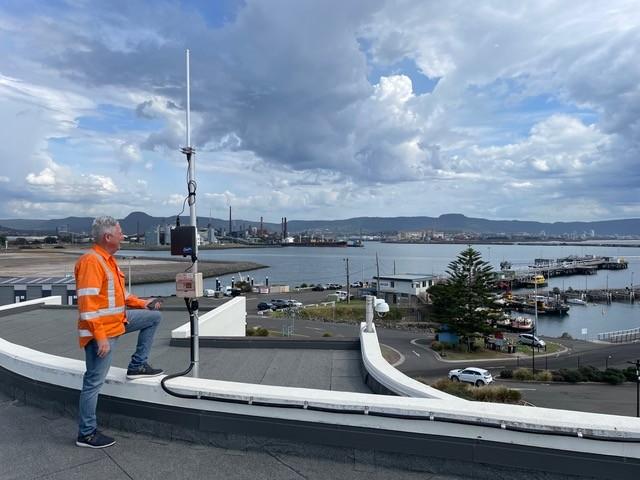
Omniflex has helped New South Wales Ports improve its ability to track water usage by installing remote monitoring to 38 water meters at its Port Kembla site, sending the data to the NSWPorts web portal. The system provided uses LoRaWAN transmitters on each meter and a LoRaWAN gateway at the management office to allow port management to conduct daily consumption analysis. Port management will now benefit from early detection of leaks and system failures, more accurate cost tracking for individual sites across the port and improved ability to report on environmental, social and governance (ESG) issues.
Port Kembla spans about 50 km and is a multi-use port, including fertiliser plants, grain silos, wind turbine blades and automobiles, making it a critical port for the region. As the port is tenanted and water usage can vary drastically depending on a tenant’s application, accurate water usage monitoring will significantly improve cost tracking and improve the port’s ESG reporting capabilities.
Various water meters, depending on age and manufacturer, track usage to varying degrees of accuracy and measure over different time periods. To monitor and report on site-wide water consumption, Omniflex had to adapt twelve different types of water meter of various ages, from decades old to brand new, and arrange data pickups for them as well as check all data pulse calibrations to determine the litres per pulse.
The LoRa-based system that Omniflex provided for New South Wales ports allows port managers to collect data from new and old water meters alike. Furthermore, by using Omniflex’s Data2Desktop software, the system makes data output as easy to access as possible while effectively managing incoming data to ensure managers get the right information from the right meter.
“As well as technical challenges associated with creating a system that effectively tracks and reports usage from water meters of very different makes and ages, there were also practical challenges to consider for a job like this,” explained David Celine, managing director of Omniflex. “With some water meters being 20- to 30-years-old, they were often found to be very dirty, bordering on unreadable, adding time needed to identify its type and how it works before it could be connected correctly.
“These kinds of practical challenges, while not always immediately apparent, are an important consideration for utilities monitoring jobs like this and, fortunately, our team is experienced and well-equipped to handle them,” concluded Celine.
“The new data has already proven useful as our sustainability team is now better equipped to monitor water consumption across various sites,” commented Mark Jafar, Asset Management Engineer at New South Wales Ports. “This insight may help identify opportunities for stormwater tank installations, where appropriate.”
For more information on web-based remote monitoring, visit Omniflex’s website.