
Researchers at the University's Structural Timber Innovation Laboratory are breaking ground with durability programmes to open new applications for low carbon cross-laminated timber in demanding outdoor environments.
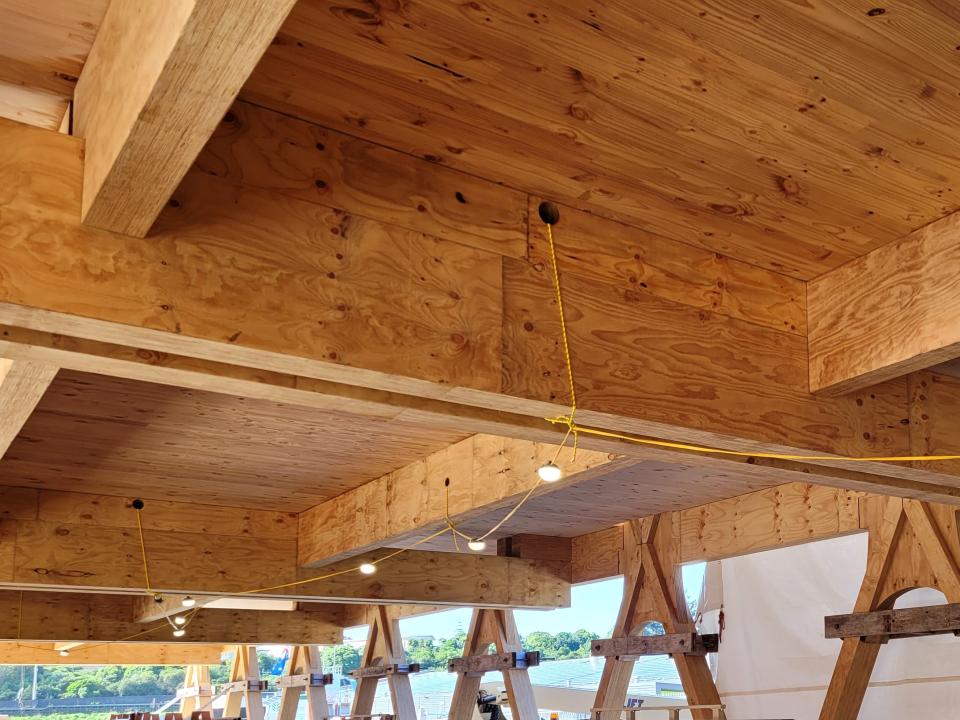
The novel product, which is made by stacking layers of thick solid wood boards crosswise and gluing them together, is increasingly used as a low-carbon option for walls, floors and roofs in buildings.
However, its use it largely limited to indoor environments, and has only rarely been used in applications such as bridges, facades, outdoor pavilions and other infrastructure.
"Our research aims to change that," says Dr Gary Raftery, a research director in the University's Circular Innovations Research Centre.
The team is conducting a series of long-term exposure trials using both outdoor and lab experiments that simulate extreme conditions.
They will then analyse the product using advanced tools, including a high-powered microscope that can reveal information in relation to the deterioration and a tool that can read 'chemical fingerprints'. This allows the engineers to identify the composition of the material and track how its chemical structure could change over time.
Raftery says cross-laminated timber is known for its strength and architectural versatility, but unprotected exposure to the elements can lead to biological degradation like rot and mold, dimensional instability and structural compromise.
Working with industry partners, the team is meticulously assessing adhesive and preservative systems to augment the performance of cross-laminated timber, while keeping sustainability front-of-mind.
"We want to ensure that solutions align with circular economy principles, so cross-laminated timber elements can be reused, repurposed, or recycled at the end of their service life," he says.
"This data will give designers the confidence to adopt more sustainable construction practices and further support a transition to low-carbon construction."
Life-cycle analysis on end-of-life applications is also being conducted to assess environmental impacts.
Early findings are already informing design engineers and may contribute to future updates to building standards.