
Poor surface finishes, broken tools and lost productivity — excessive vibration is one of the most persistent and costly challenges in milling. But with the right strategy and tooling, it doesn’t have to be. Here, Barry Cahoon, Product Solution Specialist - Rotating Tools, at Sandvik Coromant offers expert guidance to help manufacturers machine with greater stability, precision and confidence.
Vibration is a natural part of any cutting process. but when left unmanaged, it becomes a significant barrier to productivity and quality.
In milling, vibration accelerates wear on machine components, resulting in costly repairs, reduced equipment lifespan and unplanned downtime. The noise it generates can also contribute to a less safe and more stressful working environment for operators.
In industries where precision and reliability are non-negotiable — such as aerospace, oil and gas, medical device and automotive manufacturing — the consequences of vibration are especially severe. Poor surface quality and even subtle dimensional deviation can cause components to fail stringent industry standards or, worse, malfunction in their applications.
Given these risks, managing vibration is essential for maintaining part quality and ensuring efficient, cost-effective operations. The first step in prevention is understanding its cause.
Understanding vibration
Vibration often begins with instability in the machining setup. Long tool overhangs, thin-walled components, poor fixturing or unsecured workpieces can reduce system stiffness, which triggers various forms of vibration. Each form of vibration comes with its own consequences.
The first is natural or free vibration. This happens when a component is disturbed and oscillates without any ongoing external force, for example, after being displaced during setup or part handling. While usually not harmful on its own, it can interfere with cutting when it interacts with other forces.
Forced vibration is more common and occurs due to repetitive external influences, such as tool imbalance, machine misalignment or fluctuating cutting loads. These create regular, repeatable oscillators that disrupt tool engagement and degrade surface finish.
More problematic is self-excited vibration, or chatter. This occurs when variations in cutting forces feed back into the system and amplify with each tool pass, leading to high-frequency oscillations, erratic cutting behaviour and poor surface finishes. Often marked by distinctive sound and visible ripple marks, chatter reduces accuracy, shortens tool life and makes it nearly impossible to meet tight tolerances in high-precision manufacturing environments.
Identifying the source of vibration is just the beginning. Managing it effectively requires the right machining strategies and tooling.
Strategies for stable milling
To manage vibration and unlock consistent performance, manufacturers should focus on three key strategies: reducing tool overhang, optimising cutting data and choosing geometry that supports stable cutting.
Minimising tool overhang is one of the most effective ways to increase system rigidity. The longer the tool extends from the holder, the more its stiffness is reduced, amplifying minor cutting forces into disruptive oscillations.
In most cases, mitigating this is as simple as shortening the tool setup to reduce extension. However, where long overhang is unavoidable, such as deep cavity milling for aerospace components, damped tooling solutions like Silent Tools can make a significant difference. This suite of tools for milling incorporates internal damping mechanisms to absorb vibration at the source, maintaining cutting stability, improving surface finish and supporting higher cutting parameters.
Optimising cutting data is another vital way to reduce vibration. Excessively high feed rates, engagement depths or spindle speeds, especially in already unstable setups, can cause instability.
Manufacturers can stabilise the milling process by carefully adjusting the spindle speed, feed per tooth and engagement angles of the cutting tool during machining. Even minor adjustments can significantly reduce vibration without compromising productivity. This is most effective when combined with adaptive machining strategies, which enable smoother engagement and minimise the risk of chatter, particularly in thin walls or complex contour operations.
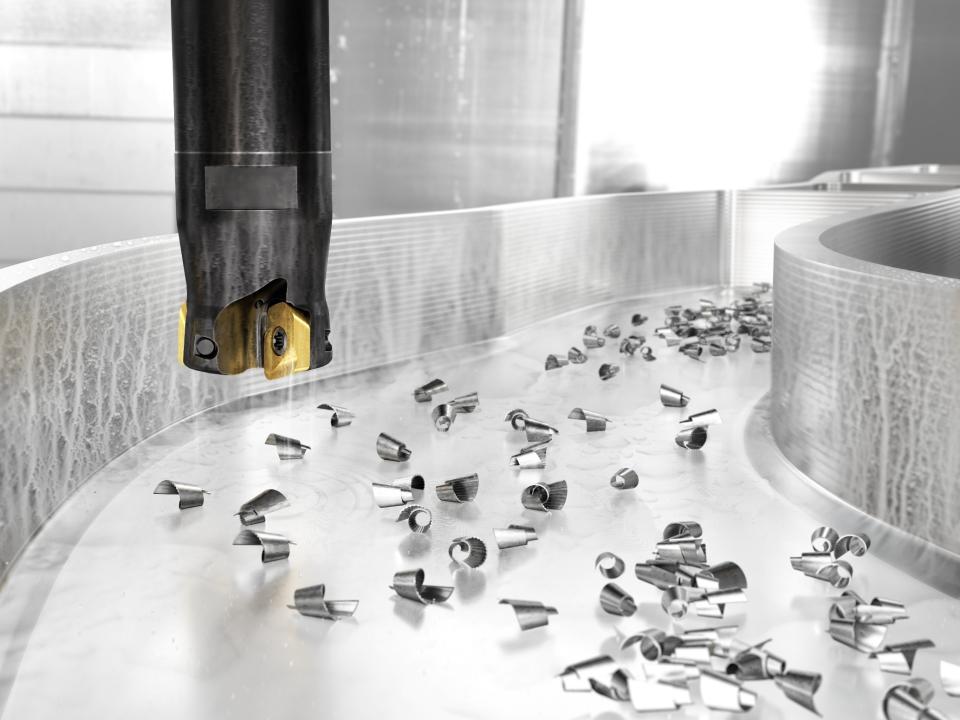
Choosing the correct tool geometry also plays an important role. Tools that generate lower cutting forces and offer stable edge-line engagement are less likely to excite vibration, especially in lighter-weight machining. Featuring a strong insert interface and geometry, CoroMill MH20 is designed for dynamic shoulder and pocket milling. Its secure cutting action reduces tool deflection, whilst supporting longer tool life and consistent part quality.
Overcoming vibration isn’t about a single fix. It requires a systems-wide view. From minimising overhang to selecting the right tooling and refining cutting conditions, every element of the process contributes to a more stable, productive milling environment. With the right strategies in place, manufacturers can machine with greater confidence and achieve the high-quality results their industries demand.
For more advice on how to reduce vibration in milling, please visit the Sandvik Coromant website.