

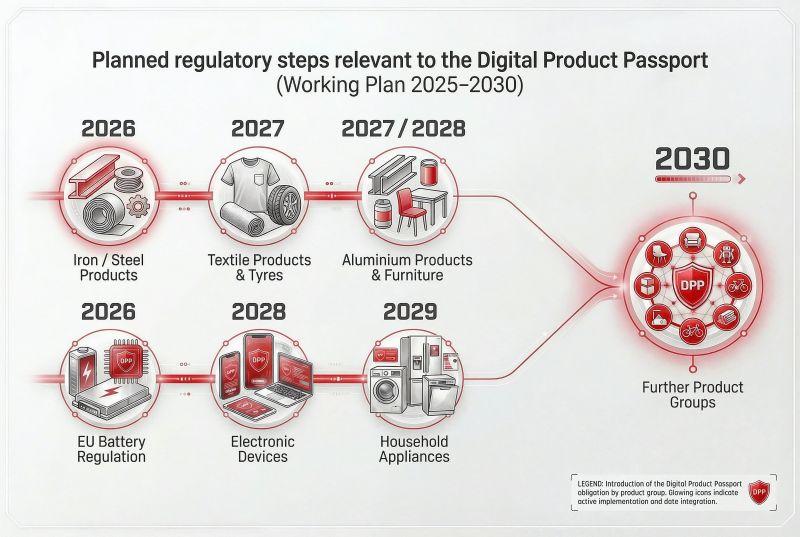
From 2030 onwards, products in the EU are expected to carry a digital identity: the “Digital Product Passport” (DPP) will become mandatory for many industries. This new level of transparency is made possible by the global adoption of GS1 2D codes. In Europe, sustainability and the circular economy are thus increasingly becoming a legal requirement, no longer merely voluntary goals.
The legal foundation: ESPR
Under the EU Ecodesign for Sustainable Products Regulation (ESPR) — enacted by the European Parliament and the Council of the EU (following a proposal by the European Commission) — manufacturers will, in the near future, be required to provide detailed, standardised product data in digital form for certain product groups. The regulation aims to make all products on the EU market more durable, repairable, resource-efficient, and traceable throughout their lifecycle.
Introducing the Digital Product Passport (DPP)
At the heart of this new framework lies the Digital Product Passport (DPP). Its goal: to create transparency by documenting essential information about a product’s composition, origin, repairability, and environmental footprint. The DPP will make it easier for authorities, businesses, and consumers to understand how sustainable a product really is — and to make better choices based on that knowledge.
Implementation roadmap: 2026 to 2030
The rollout starts with prioritised product groups that are highly relevant for the environment and the circular economy — such as steel/aluminium, textiles, furniture, tyres and mattresses (Work Plan 2025–2030). In parallel, the Work Plan includes horizontal measures, including requirements in the context of electrical and electronic equipment (e.g., on recyclability). Independently of this, the Battery Passport will already apply to batteries from 18 February 2027.
Step by step, more and more product groups in the EU will thus receive a digital identity that is accessible throughout the entire lifecycle — from production to recycling.
Why GS1 2D codes matter
To make this vision work, each product needs a globally unique identifier and a standards-based way to connect it to digital information. That’s where 2D barcodes powered by GS1 come in: whether printed as a GS1 DataMatrix or a QR Code powered by GS1 (using GS1 Digital Link), these symbols can link physical products to their digital twins, storing or connecting to verified data about materials, origin, and reuse.
In this new landscape, the once-humble barcode evolves into the language of the circular economy — and the GS1 2D code becomes its universal translator.
Smart packaging and new business models
As packaging goes digital, new opportunities emerge. Products equipped with 2D codes can “communicate” with machines, sensors, and applications. Manufacturers gain real-time insights into sales, returns, or recycling rates.
For consumers, transparency becomes tangible: a quick scan reveals CO₂ footprint, sourcing, or end-of-life instructions. Brands can use this data to strengthen trust and loyalty while complying with sustainability regulations.
What sounds futuristic today — a bottle that reports when it’s recycled — could soon be a daily reality.
Opportunities for producers and printers
For packaging producers, the shift toward 2D-driven smart packaging is both a challenge and an opportunity. Those who start now will shape future industry standards. At the same time, print quality becomes more critical than ever: smaller, denser codes with variable data demand precision, stability, and flexibility.
Powerful printing technologies are essential to meet these requirements. LEIBINGER is a technology leader in industrial continuous inkjet (CIJ) printing. The company’s systems enable reliable marking of complex 2D codes on a variety of materials and ensure consistently high readability throughout the entire product lifecycle.
Conclusion
The GS1 2D code is more than a compliance milestone — it’s the foundation of connected, circular, and sustainable production. As the digital product passport becomes reality, packaging will evolve into a transparent interface between producer and consumer.
With LEIBINGER’s commitment to innovation and precision, manufacturers can be ready today for the requirements of tomorrow.
The next part of the LEIBINGER series on 2D code migration presents practical best practices and case stories on the transition to 2D codes. All previously published articles in the series are available at leibinger-group.com.