
New world-first technology developed to prevent design errors from cascading throughout the country’s most complex construction project to date could reduce cost overruns in New Zealand’s $275bn infrastructure pipeline by millions of dollars, as well as cutting new building emissions by up to 80%, according to new data.
Modelling from the Government’s $290m Te Rua National Archives shows that if digital twin technology is introduced from the design stage of large-scale projects to identify and address flaws across the infrastructure pipeline to the levels achieved on Te Rua, where contingency spend was held to five percent against an industry average of up to ten percent, New Zealand could potentially avoid millions of dollars in construction cost overruns.
Data also shows that the preventative maintenance capability of the technology could reduce operational carbon emissions of a building by up to 80%.
It is believed that with the integration of AI, the methodology could also be adapted for use in New Zealand’s planned multibillion-dollar healthcare infrastructure programme to produce clinically safer environments for patients.
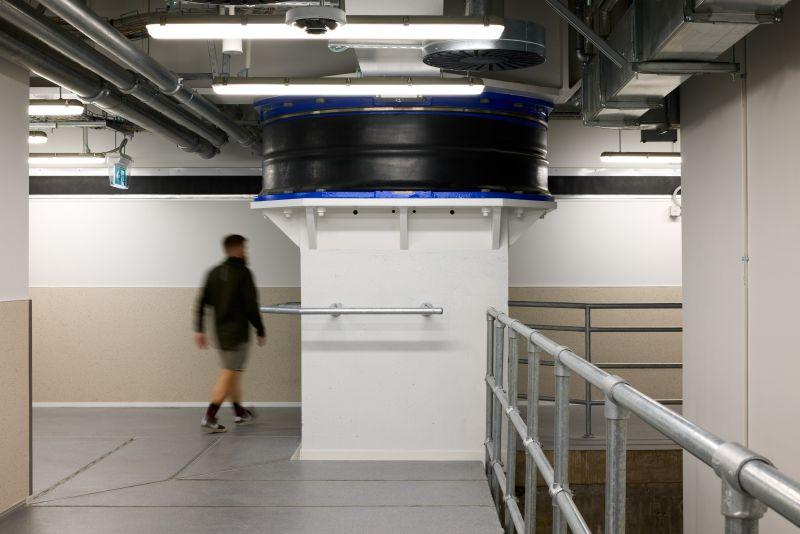
The recently completed Te Rua Archive in Wellington is the most technically demanding building ever constructed in New Zealand. Designed to remain operational after a one in 1,800-year earthquake, it must maintain temperature and humidity within a one-degree tolerance for at least 48 hours in a power failure to protect taonga and government records held under UNESCO Memory of the World obligations.
Phill Stanley, portfolio manager for ASX-listed Dexus, says these performance requirements meant the project could not rely on traditional construction methodologies, as even minor errors would have compromised the stability of the collection.
“When you are managing irreplaceable taonga and national records, there is no margin for error. Any design flaw that affects temperature, humidity or structural performance directly threatens the integrity of the collection, so we needed absolute certainty that every element of the building would perform exactly as intended, not just on day one but for decades to come.”
The digital twin created for Te Rua generated a three-dimensional virtual design environment that allowed architects, engineers and contractors to detect and resolve clashes before they occurred on site. A clash is a conflict that occurs when two parts of a building are designed to occupy the same physical space, meaning they cannot both be built as drawn. These errors are common in complex projects and can cause major delays and cost blowouts once contractors discover that services, beams or mechanical systems physically cannot fit together on site.
The archive’s model was ‘clash-free’ at the tender stage, which is an accuracy level not previously seen in complex civic construction in New Zealand. Contractors used on-site stations connected to the live design so they could install services with millimetre accuracy, and augmented reality was deployed for quality assurance during installation, which allowed the design team to validate work in real time.
The system was customised extensively for Te Rua with climate control and viewing tools built to meet exact archival tolerances. It can simulate full or partial power outages, test generator performance, monitor structural movement through accelerometers and give preservation teams direct visibility of conditions that could compromise historic material.
Stanley says the technology was adopted to reduce the operational risks associated with a building that must protect national records in perpetuity.
He says that while no two infrastructure projects are identical, achieving these financial results on a project of this complexity demonstrates substantial, repeatable savings potential across the broader infrastructure pipeline.
“This really does lift the bar in a way we have not seen before. It shows what is possible when everything is coordinated from day one. The scale of the model and the accuracy behind it are unlike anything we have worked with in New Zealand. For us, it gave a level of design certainty you just do not get on projects of this complexity.
Stanley says the technology is particularly suited to hospitals that have high service density and heavy environmental loadings.
He says digital twins could also support data centres, water storage facilities and civic buildings and may eventually be used in large residential developments to give occupants direct access to energy and maintenance information.
“The technology has clear applications across New Zealand’s planned healthcare infrastructure spend.
“The next generation of hospitals, including the new Dunedin Hospital, the redevelopment of Nelson Hospital, the expansion of Wellington’s Emergency Department and major upgrades across Auckland’s hospital network, will all require the same level of coordination and environmental performance delivered at Te Rua.
“These facilities rely on uninterrupted power, complex mechanical systems and precise climate control and even minor faults can create clinical risk.
“Digital twins could help control costs, reduce construction delays and ensure clinical spaces meet strict operational and environmental requirements from the day they open.”
Stanley says while New Zealand has previously been slower to adopt digital design, that gap now represents a chance to reset industry practice and prevent the design clashes that traditionally surfaced only once construction was underway.
“You cannot retrofit this level of coordination. You have to make the decision right at the start or you lose the opportunity. Once you commit early everything else becomes more predictable.”
Once the building opened, the digital twin became a live facilities management system. The project embedded over 20,000 assets into the operational model which now provides real time information about temperature, humidity, energy use and structural movement.
Facilities managers can monitor performance and address faults before they become disruptive which supports long term resilience and significantly lowers ongoing costs. Data shows the building has already achieved an 80 percent reduction in operational carbon which equates to 1,330 tonnes through smart monitoring and control of environmental systems.
Stanley says the next generation of the technology will begin integrating AI so it can learn from patterns of use, detect subtle changes in performance and autonomously recommend adjustments before problems appear.
He says this will allow facilities teams to shift from routine monitoring to fully predictive asset management.
“Systems will be able to flag components that are likely to fail months in advance, automatically adjust environmental settings to reduce energy waste and analyse seismic or structural data to identify early signs of stress that are invisible to the human eye.”
Nik Kemp, executive general manager for growth markets at Dexus, says the archive was delivered in partnership with the Government, which enabled the technical seismic and cultural requirements to be met.
“From the outset we knew that cost certainty was non-negotiable. When you are delivering a project of this complexity on behalf of the Government, the risk profile is significant and the tolerance for cost drift is very low. The digital twin gave us the visibility we needed to keep the budget stable while still meeting seismic, cultural and archival performance requirements that were unlike anything attempted in New Zealand. It allowed us to manage risk in a disciplined way and give the Government confidence that the project would be delivered exactly as promised.
“For anyone delivering civic infrastructure this kind of approach is fast becoming essential. It gives you real clarity on design and cost and confidence that the finished asset will perform the way it needs to. My view is that this will become the gold standard for major projects. At its heart it is not just about better buildings. It is about better collaboration and better relationships,” he says.