
Composite materials are transforming industry, but the act of machining them remains a persistent challenge. Even with advanced machinery and process controls, cutting fibres and resin still test both engineering and operational skills. Here, Liam Haglington, Product Manager for solid carbide end milling tools at global leader in cutting tools and machining solutions, Sandvik Coromant, explains how advanced tool design and materials engineering are helping manufacturers overcome the limits of abrasive composite milling.
Lightweight, high-strength composites like carbon fibre reinforced polymers (CFRP) promise unmatched performance, offering high stiffness to weight ratios, corrosion resistance and design flexibility that enable lightweighting strategies.
Aerospace remains the most demanding application for composites. Components such as fuselage frames, wings, stabilisers, spars, ribs and floor beams are critical to structural integrity and often machined in high-volume precision environments. Composites are especially suitable for these aerospace structures because they offer a high stiffness‑to‑weight ratio, excellent fatigue resistance and can be tailored through fibre orientation to deliver strength exactly where it is needed: properties that are essential for lightweight, high‑performance airframe components.
Other industries also benefit. Automotive manufacturers use CFRP to reduce weight and improve efficiency. According to JEC, composites are “critical for applications where lightening remain a key priority to enhance fuel efficiency and limit the emissions of greenhouse gases”, and now represent around 17% of materials used in aerospace and 8% of materials used in the transportation sector. In all these sectors, stable process control and reliable tooling directly translate into cost savings and production confidence.
Why composite machining is so challenging machining composites is very different from machining metals. Composites combine stiff, abrasive fibres with a softer resin matrix, and every change in fibre orientation alters how the material behaves in the cut. What appears uniform on the surface is a constantly shifting environment for the tool.
This shifting behaviour creates familiar defects for composite manufacturers: delamination can occur when layers separate under excessive forces, uncut or pulled-out fibres appear when the tool cannot sever the reinforcement cleanly and surface quality can become inconsistent when fibres and resin respond differently to heat and pressure. These issues all come from the same underlying cause. The material does not behave consistently, and its failure modes are unpredictable.
The effect on production can be significant. Defects lead to scrap, more inspections, rework and the possibility of stopped production lines, especially in high-precision aerospace environments where nonconformance cannot be accepted.
Heat sensitivity adds another layer of difficulty. If temperatures rise, the resin softens while fibres stay rigid, which increases the risk of delamination or fraying. If cutting is too cold, the resin stays brittle and tool wear accelerates. Cutting parameters need to be controlled with precision, yet conventional tools often struggle to strike the right balance. The result is rapid wear, uncertain tool life and reduced component quality.
Reliable machining depends on tools designed to stabilise the process, control vibration and manage heat. Without this level of control, composite machining remains a challenging and unpredictable task.
Engineering the solution: CoroMill Plura composite 2P350 Meeting these demands requires a tool designed not just to cut the material, but to control how fibres separate and how wear develops over time. The CoroMill Plura composite 2P350 was developed with these goals in mind.
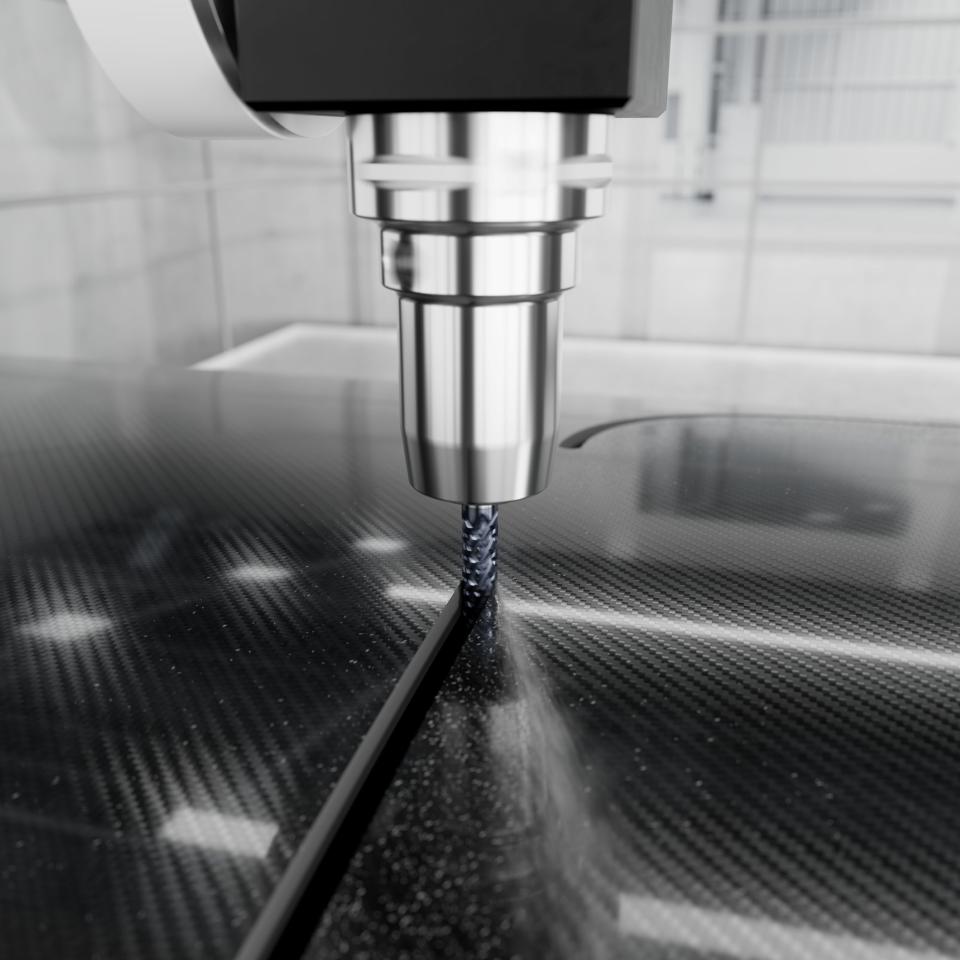
At the heart of the 2P350 is an original dual-cutting mechanism. Unlike conventional end mills, it slices fibres cleanly rather than tearing them. The mechanism works with a scissor‑like action that brings two cutting edges together to lift and shear the fibres in a controlled way. One edge guides the fibres while the other cuts them, which keeps the laminate stable and helps prevent delamination. This coordinated action also evens out the cutting load, which reduces vibration and creates a more consistent and predictable machining process.
The tool’s geometry is optimised to deliver high productivity. Large flute volumes ensure effective evacuation of dust and loose fibres generated during cutting. Clearing them quickly reduces the risk of recutting and helps keep the cut stable and clean. Whether slotting, ramping or edging, the 2P350 performs from roughing to finishing in a single setup. Lower vibration and consistent cutting action also make the shop floor quieter and more comfortable.
The CoroMill Plura composite 2P350 maintains cutting behaviour across a wide range of conditions, allowing manufacturers to maintain consistent quality regardless of workpiece or tool-holding variations. The controlled cutting mechanism improves performance on complex operations, which is particularly valuable in unmanned or lights-out manufacturing where operators cannot intervene. Predictable tool behaviour and lower vibration reduce the likelihood of sudden tool wear, enabling continuous production and reducing reliance on operator experience.
The power of O2AD Geometry alone, though, is not enough in abrasive composite applications. Edge reliability must also withstand continual exposure to reinforcing fibres, which is where the O2AD grade becomes important.
The O2AD grade combines advanced materials engineering with a thick high adhesion chemical vapour deposition diamond coating. The tailored substrate ensures optimal bonding between the diamond layer and tool body, preventing premature coating delamination and extending tool life.
Field and internal testing show that tool life roughly doubled compared with the previous O12M grade. In one aerospace case involving an aircraft wing component machined dry with vacuum on a 5-axis gantry, the O2AD grade delivered a 100% improvement in tool life compared with O12M under the same cutting conditions. The wear pattern is predictable and progressive, giving manufacturers confidence to push cutting parameters while reducing scrap and tool changes. This creates tangible cost savings through longer cutting windows, reduced tool inventory and less downtime.
By combining this diamond coating strength with a stable substrate, the O2AD grade directly addresses the main challenges of composite milling. Consistent edge quality maintains steady cutting forces, supports low vibration, and creates a more predictable machining process. Manufacturers can achieve cleaner cuts, more consistent tool life, and more reliable results across abrasive composite materials.
CoroMill Plura composite 2P350 with O2AD grade is more than a milling tool. It addresses abrasive wear, delamination risk, thermal sensitivity and vibration while enabling high-quality parts with consistent performance regardless of complexity or variability. From aerospace to automotive, defence, space and marine applications, the 2P350 helps manufacturers boost productivity, protect part integrity and control costs. For manufacturers facing the challenge of the unmachinable, CoroMill Plura composite 2P350 sets the new benchmark in reliable high-performance composite milling.
Stepping back to the wider challenge, these advances show how progress in geometry and materials engineering is reshaping what is possible in composite machining. Delamination, fibre variability and heat sensitivity will always be part of working with these materials, yet the right technology can overcome these barriers and ensure stable and predictable operations.