
Scraped surface heat exchangers (SSHEs) are widely recognised as the best solution for heat transfer applications – such as pasteurisation, cooling or sterilisation – involving thick and viscous food products as removing product from the tube surface prevents fouling and the same scraping action provides thorough mixing and distribution of heat (or cold) in the product. However, what happens when thorough mixing has the potential to physically alter the product, as can happen with some creams, sauces, and products containing pieces, such as fruit purees?
Most SSHEs use a rotating shaft with blades or augers which scrape the surface of the tube, and the popular HRS R Series is based on this approach. However, depending on the nature of the product, the forces created can lead to shearing or splitting. To overcome such issues and preserve the quality and integrity of delicate food products such as cheese, yoghurt, ice cream, meat paste, and products containing whole pieces of fruits or vegetables, HRS developed the HRS Unicus Series of reciprocating scraped surface heat exchangers.
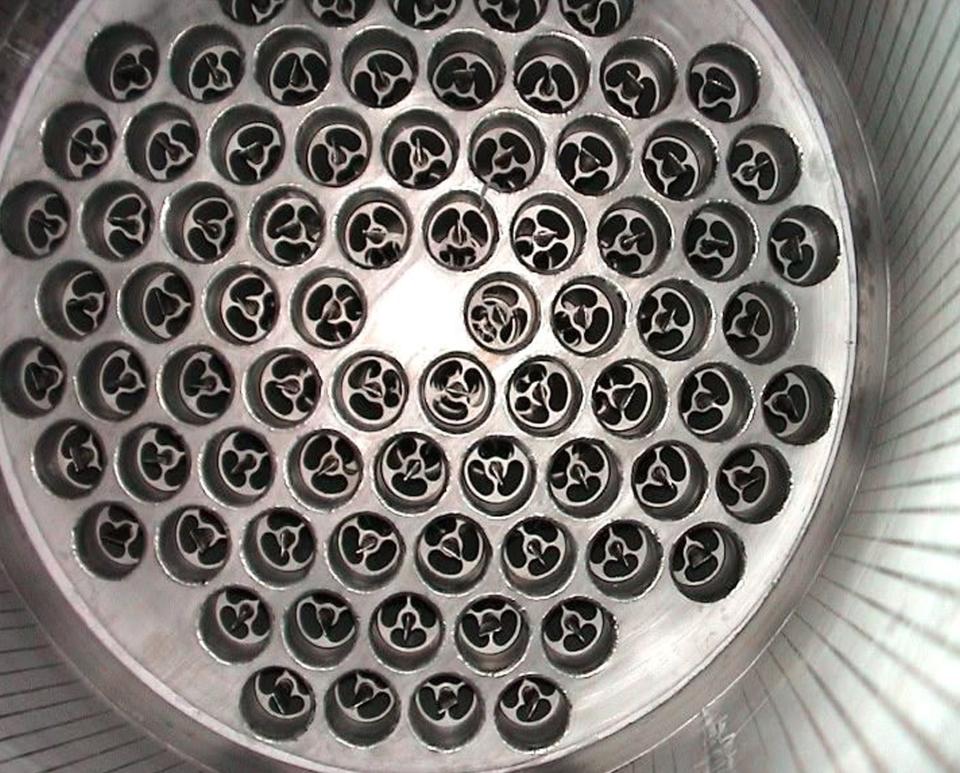
The HRS Unicus Series uses a patented and hygienic stainless-steel scraping mechanism which moves hydraulically back and forth within each interior tube. This movement performs two key functions: it minimises potential fouling by keeping the tube wall clean and creates turbulence within the product. Taken together, these actions increase heat transfer in the material, creating a highly efficient yet gentle process which is ideal for delicate but viscous and high fouling products.
However, because the speed of the scrapers can be controlled separately and a number of different scraper designs have been developed for different products, the action of the Unicus Series and the speed of the scrapers, can be optimised for a particular product being processed. This means that products which are susceptible to shear stress or pressure damage (such as creams, custards and sauces) can be handled delicately and at lower pressures to prevent damage while still providing high levels of heat transfer.
Each Unicus Series consists of three elements: a hydraulic cylinder and power pack, a separation chamber to ensure hygiene and preserve product separation from the motor, and the heat exchanger itself. The heat exchanger consists of a number of tubes, each of which contains a stainless-steel rod to which the appropriate scraping elements are fitted. Using a range of food-safe materials including Teflon and PEEK (polyether ether ketone), these provide different internal geometry setups according to the application, such as 120° scrapers for large particulates and 360° scrapers for viscous fluids without particulates.
A standard range of Unicus models for food processing provide heat transfer areas from 0.7 to 10 m2, while specially designed seals separate the inner tubes from the separation chamber. Like the scrapers, these are tailored to the product application and prevent leakage of the product ensuring internal and external hygiene.
The Unicus Series has proven particularly useful in handling viscous food products where texture and consistency are important attributes. The Unicus Series is particularly suitable for evaporation applications, where preventing fouling is particularly important. Because of this, HRS has developed a specific version of the Unicus Series for use in evaporation units where volume reduction of the product is required. The scraping action keeps the heat transfer surfaces clean so that Unicus evaporators can concentrate materials to a level that is unattainable using traditional technologies. Unicus evaporators can be used in multi-effect setups or in combination with mechanical vapour recompression, where suitable.