
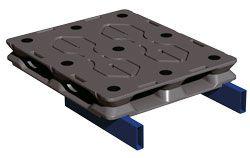
HAMILTON-based plastic pallet manufacturer Pallenz Plastics Ltd has announced a significant change to its two piece racking plastic pallet. As a result of requests from clients, and research in New Zealand and Australia the company has commissioned changes to the lower section of the pallet to add a rebate that coincides with standard selective pallet racking systems and provides a positive positioning point. When slid onto the pallet rack the rebate on the pallet base will minimize the chance of the pallet or bin being dislodged accidentally by fork hoists or other unforeseen circumstances such as earthquakes or ground tremors. Careful design and testing resulted in a dual country system, with the rebate being suitable for use on both domestic and Australian selective pallet racking. With the commissioning of a moulding machine the size of a small house and weighing 180 tonne, Pallenz has increased its production capacity to ten times the speed of rotational plastics moulding – providing faster turn-around on orders and a significant increase in quality and consistency. Pallenz Plastics has been designing and making plastic pallet systems in New Zealand for over 14 years and now builds all product at a purpose-built manufacturing facility in Hamilton. The plant is capable of moulding the entire range of Pallenz products including the Palmart collapsible pallet bin, racking and platform pallets, and injection moulded parts such as the patented J-Bolt (a device designed to hold RFID or GPS tags and other devices). “The ability to upgrade an existing pallet to include a new feature is just one of the benefits of our new generation design – no longer does a pallet have to be replaced, recycled, or taken out of commission simply because one surface has sustained damage,” says Pallenz group marketing manager Greg Gibb. Other built-in safety features of the two piece racking pallet include rubber friction points on the upper surface to minimize load slippage, built-in carry handles and lighter construction to reduce personal injury when handling the pallets without a fork hoist, and numerous deflection points to ensure that when approached from an incorrect angle any chance of the pallet being pushed away is minimized. “Our pallet systems are designed to be safe to use, efficient, and cost effective” says Gibb. “And add to that our ability to make certain product changes on the go and manufacture in alternative materials, and you can immediately realize why purchasing New Zealand made is the best option. For example, we recently discovered that the moulded-in rubber pads on one of our pallets were not suitable for a specific client application – solution, an injection moulding tool modification on the same day and problem solved.”
New plastic pallet design improves safety
General
Sunday, 30 December 2007
Related Articles

Wednesday, 23 September 2026
After 219 nominations uncovered some of New Zealand’s best workplace coaches last year, industry training organisation Competenz is kicking off another season of its Most Valuable Coach (MVC)...
Wednesday, 23 September 2026
Australian engineers have created a strong and lightweight titanium material that floats in water, even after severe damage, revealing a promising new material for marine infrastructure.
Research...

Wednesday, 23 September 2026
A new Kiwi-developed pavement and geotechnical verification records software is turning geotechnical reports into structured evidence for roading and infrastructure teams.
Led by Hamilton-based...