
Watson-Marlow 520 and 620 Series pumps prove their reliability in conjunction with Thames Water’s process plants.
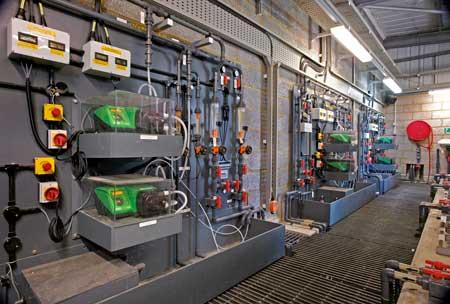
Tasked with replacing ageing pumps for disinfectant and coagulant processes at Thames Water’s Advanced Water Treatment Works (AWTW) in Walton, Surrey, engineering, consulting and construction company Black & Veatch and TW opted to install a number of 520 series and 620 series peristaltic models from Watson-Marlow Pumps Group. Offering continuous, high pressure and quick release functionality, the new pumps have slotted comfortably into their high-tech surroundings at Walton, which is one of Thames Water’s flagship process plants.
Although a water treatment works has existed on the site at Walton-on-Thames since 1926, it was a £47 million upgrade in the 1990s that pushed the facility into the premier league of process plants. The upgrade included the adoption of new advanced water techniques such as the CoCoDAFF (counter-current dissolved air flotation and filtration) system, which offers the enhanced solids separation capability of dissolved air flotation, while providing the cost benefits of DAF and granular media filtration – all within the same footprint.
Walton AWTW plays an important role in the life of Thames Water customers as one of the five AWTWs on the Thames Water ring main, ensuring that the ever increasing demand for high quality drinking water is met. Walton feeds the ring main with approximately 50 million litres of treated water per day.
Several processes reliant on pumping operations are vital to the advanced water treatment process at Walton. For instance, pre-ozonated water is mixed with a coagulant in the flocculators to aid the production of large flocs, which are floated more easily in the subsequent CoCoDAFF process. The addition of coagulant is today facilitated by newly installed 620 series pumps from Watson-Marlow.
Historically this site has had close association with peristaltic pumping technology. ”While the previous 504 series pumps for the coagulant process were reaching the end of their natural life, they had performed well so it was decided to continue with this type of pump,” explains Ken Ingram, Black & Veatch’s project M&E co-ordinator at the Walton site.
Watson-Marlow 620 series close-coupled pumps are pumping inorganic polymer coagulants such as ferric sulphate, which perform well with thick flocs and offers fast sedimentation.
The water is then treated using CoCoDAFF and passes through post-ozone and granular activated carbon (GAC) contactors, as well as slow sand filters before arriving at the disinfection stage, where sodium hypochlorite is introduced to contact tanks in doses using 520 series Watson-Marlow pumps. The residual is controlled into the supply by adding a further dose of either more hypochlorite to increase the residual, or sodium bisulphate to reduce the residual to a set point. Ammonium sulphate is then added to combine with the residual to form chloramine before being pumped into the supply.
Sodium hypochlorite is a highly corrosive chemical that has disinfection and bleaching properties. It is used in the purification of wastewater and the disinfection of drinking water. However, dealing with the chemical can be difficult as it is toxic and emits chlorine when in contact with acids. It naturally releases tiny bubbles of gas, which have a tendency to collect on the small ball valves found in conventional diaphragm dosing pumps. This can cause gas locks in the system, which prevent the pumps from functioning. Because peristaltic pumps retain the fluid completely within the tube and have no valves that can leak or corrode, they can be used for the accurate metering of substances as challenging as sodium hypochlorite, without the associated gas locking and maintenance problems. Peristaltic technology therefore helps to keep costly downtime at the site to a minimum.
A total of ten Watson-Marlow 520 and 620 Series pumps at Walton since June 2009. “These are advanced peristaltic pumps serving advanced water treatment processes. There is little margin for error where drinking water is involved, which is why we needed high reliability in terms of continuous operation and dosing accuracy.”
Watson-Marlow 520 pumps are designed for the specific needs of the process sector. The models at Walton feature LoadSure elements, which fit into position for simple, error-free tube loading. Using the patented LoadSure D-connectors and easy-grip clutched rotor, the element can be changed in less than one minute without the need for special skills.
“The quick-release LoadSure elements are a blessing at a plant such as Walton, where any downtime can have significant consequences,” says Mr Ingram.
To give the 520 series pumps at Walton their full model designation – 520UN/REH – these pumps rated to 7bar also facilitate analogue signals for both automated control and feedback purposes, accepting/providing 0-10V, 4-20mA, 5V TTL and 24V industrial logic inputs/outputs.
Email: enquiries@wmbpumps.co.nz