
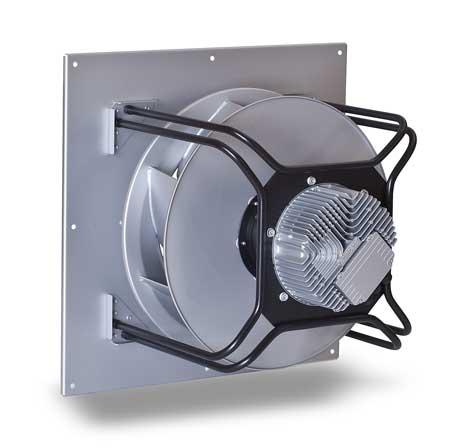
The Wakefield House Building in Adelaide, Australia, recently realised an amazing 50 percent reduction in fan energy. The new EC plug fan, which replaced the existing centrifugal belt driven fan, has not only shrunk the energy bill, but also increased airflow and cooling capacity of the air handling unit.
For commercial office buildings, up to 70 percent of the total energy use is attributed to the heating, ventilation, and air conditioning (HVAC) systems. Fan energy is typically the most significant consumer of energy within a commercial building. Approximately 50 percent of energy can be saved by replacing the existing AC belt driven backward-curved fans throughout a building to EC plug fans.
The original fan and air handling unit arrangement for level 14 of the government-owned Wakefield Building in Adelaide, which is typical throughout all floors of the building, comprised a coil face bypass arrangement, with air distributed via a belt driven backward curved centrifugal fan arrangement. In October 2011, the existing fan was replaced by an ebm-papst EC Plug fan. Minor works to the damper were also performed.
Old system vs. new system
The main issues with the above arrangement and system relate to performance and the ability to adequately distribute the air to the floor. Due to the system type and the fan’s proximity to the cooling coil, the cooling capacity of the air handling unit is reduced as only part of the coil face is utilised. Air from the fan is only incident on part of the cooling coil, which then is reflected by insufficient capacity being delivered to the floor.
The new ebm-papst EC Plug fan was installed away from the cooling coil, and the damper was rearranged above the cooling coil in the bypass ductwork. The new damper was installed to provide an equivalent pressure drop to the cooling coil, which provides more stable distribution and controllability of supply air. The EC Plug fan, pressurises the plenum chamber and rather than delivering an uneven air profile as per a centrifugal fan, it provides uniform air pressure and therefore volume across the whole cooling coil, achieving greater capacity from the coil.
The belt-driven backward curved centrifugal fan’s starting currents on each day exceeded 80 amps, whereas the average current across the phases throughout daily fan operation is 8.55 amps. With the new EC Plug fan starting currents now approach 6 amps and the average current across the phases throughout daily operation of the EC plug fan is 4.7 amps.
Contributing to the insufficient capacity of the old arrangement was the reduction in supply air to deliver cooling to the floor. Locating the fan so close to the cooling coil creates turbulence and increases the system static, which in turn reduces the supply air quantity by approximately 10-15 percent from design. When combined with the reduced performance of the cooling coil, the net reduction in capacity to the floor is approximately 45 percent from design.
As part of the EC plug fan upgrade works, airflow was increased by 10 percent returning the supply air quantity to the design figure and combined with the resultant increased coil efficiency, cooling delivered to the floor was increased by approximately 15-20 percent.