
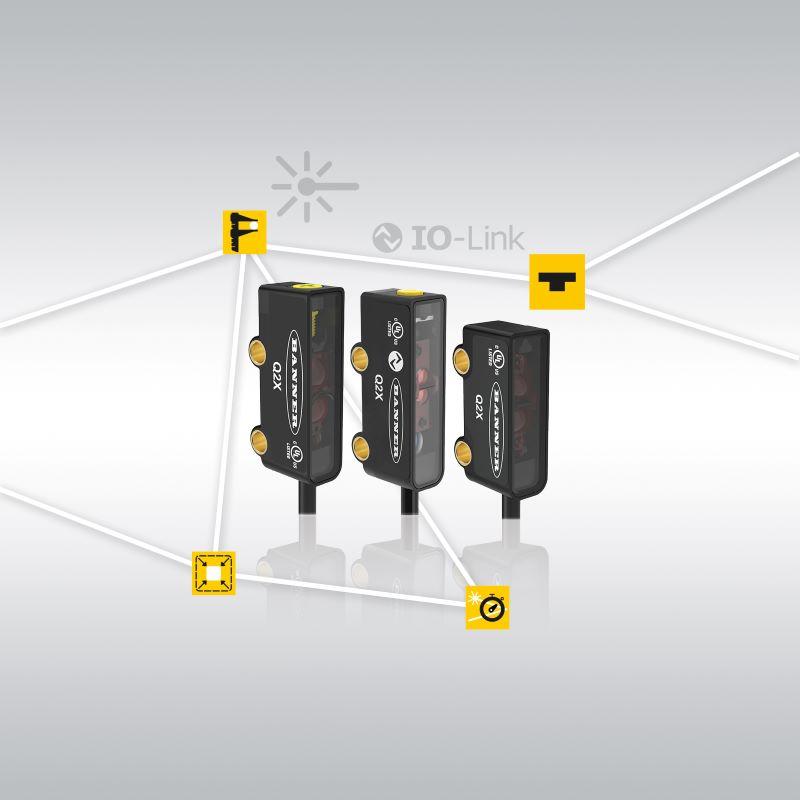
Banner's compact Q2X sensor series enables precise target detection for demanding applications even where space is limited
With the Q2X series from Banner Engineering, Turck is offering compact miniature photoelectric sensors with extreme detection ranges and five different detection modes to provide solutions for a wide range of applications. The photoelectric sensors enable precise and reliable position detection of small components and can be installed even on the smallest surfaces.
A highlight of the series is the Q2X laser measurement sensor with a range of up to 3 meters, almost four times greater than comparable models. The Q2X laser sensors use laser time-of-flight technology, which enables high-precision measurements and reliable detection of small objects.
The powerful infrared laser makes it possible to detect even the most challenging targets, such as dark or shiny plastic bags. The sensors are easily integrated into control systems using the Turck Automation Suite (TAS) IIoT and service platform which enables access to measured values and extended diagnostics via IO-Link.
The opposed mode model offers a range of up to 3 meters and minimises detection errors thanks to a large functional reserve. The polarised retroreflective model offers a fast response time of 600μs and an industry-leading range of 3.3 meters. The adjustable background suppression model allows user-defined limits, and is ideal for precise detection. Finally, the fixed background suppression model enables precise target detection with simple installation and no configuration required.
Web: www.turck.com.au