
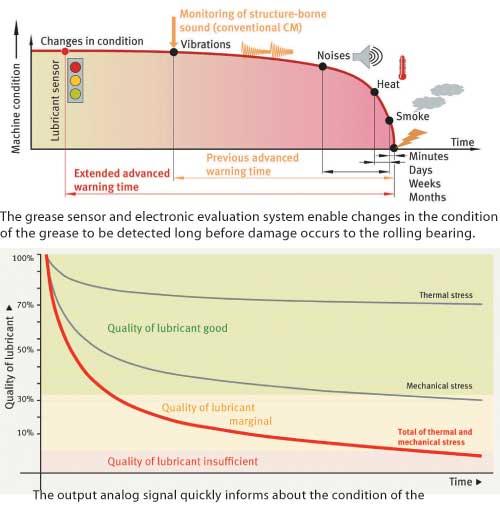
| Grease operating life is the decisive factor in maintenance. A new grease sensor incorporating an electronic evaluation system enables the condition of grease in bearings to be analysed during operation. Users now have the ability to precisely plan the schedule for replacing grease and to detect any changes in the condition of the grease long before any damage to the rolling bearing occurs. Grease will be replaced while taking actual requirements into consideration and not according to defined time periods. This reduces outlay and costs and is also beneficial to the environment and resources. Downtimes that are attributed to operational disturbances are reduced as well as the cost for lubricants, maintenance and replacement parts. At the same time, the degree of utilisation and efficiency of machinery increases. The grease operating life is the decisive value during preventive maintenance if it is shorter than the bearing life. In this case, bearings are usually re-lubricated halfway through the so-called grease operating life. The great disadvantage of this procedure is that absolutely nothing is known about the condition of the grease. Up to now, users could only receive information about the grease in bearings by taking samples and undertaking costly and time-consuming analyses of these samples in a laboratory. The grease sensor now enables the condition of the lubricant to be analysed immediately during bearing operation. The optical near-infrared reflection method is used here. The process, developed in conjunction with the Fraunhofer Institut for Electronic Nano Systems (ENAS) in Chemnitz, Germany, is based on the infrared process used in laboratories to measure grease quality and was adapted for online measurements in rolling bearings. The know-how involved is not only in the setup of the sensor, rather in particular in the evaluation of the measured signals. The grease undergoes rotationally symmetrical irradiation with certain wavelengths from the sensor. The sensor head is embedded in the lubricant during this procedure. The reflected light is measured perpendicular to the grease. This enables shadow effects and surface inhomogeneities to be completely excluded. The reflected light is evaluated in terms of the quality of the grease. Power is supplied and signals transmitted from the sensor to the evaluation cable by means of a cable. A wireless solution can also be provided. Four grease parameters can be detected using the sensor: Water content, cloudiness, wear (thermal or mechanical wear) and temperature. An analog signal (4-20 mA) is generated from these parameters in the electronic evaluation system, which displays the condition of the grease quickly and simply. A digital signal can be generated that indicates poor/good grease quality by setting a trigger threshold (limit value). This measurement method can be used for around 95 percent of greases available on the market. The new sensor was developed by Schaeffler Group Industrial in conjunction with Freudenberg Dichtungs- und Schwingungstechnik and Klüber Lubrication München. These companies have validated the method for a wide variety of greases. The online evaluation of the condition of the grease enables users to draw conclusions about any changes that may suddenly occur and, due to the digital signal, quickly react to them. Options for optimising the design and selection of the rolling bearing also quickly become apparent by using the method. |
Contact Email: sales.nz@schaeffler.com |