

Artificial intelligence (AI) has become a key catalyst for innovation within industrial automation, prompting organisations to make its integration a top priority. According to a recent survey among manufacturers, 40% reported that AI and automation have taken precedence over other digital transformation initiatives, with 80% currently allocating resources toward AI deployment. However, 30% pointed out that integration challenges remain a concern.
Automation technology specialist Beckhoff Automation is addressing these challenges by expanding its portfolio of AI solutions for the industrial sector. The company has introduced TwinCAT CoAgent and TwinCAT Machine Learning Creator, two complementary tools that extend the use of artificial intelligence across both engineering and control environments.
“One of the advantages of being an IPC-based company focused on modularity is our ability to quickly adopt and support new technologies as they emerge. This allows us to deliver cutting-edge software, such as AI and machine learning, into the hands of our customers fast, helping them gain a competitive advantage,” explains Ben Harrison, Project Manager at Beckhoff Automation. “Integrating machine learning and AI into our TwinCAT runtime is straightforward because it follows the same modular pattern as our other components. We have expanded our portfolio with a range of machine learning and neural network inference engines, all of which can be programmed and tested free of charge using our developer-friendly rolling trial license. “
TwinCAT CoAgent Supports Automation Engineers
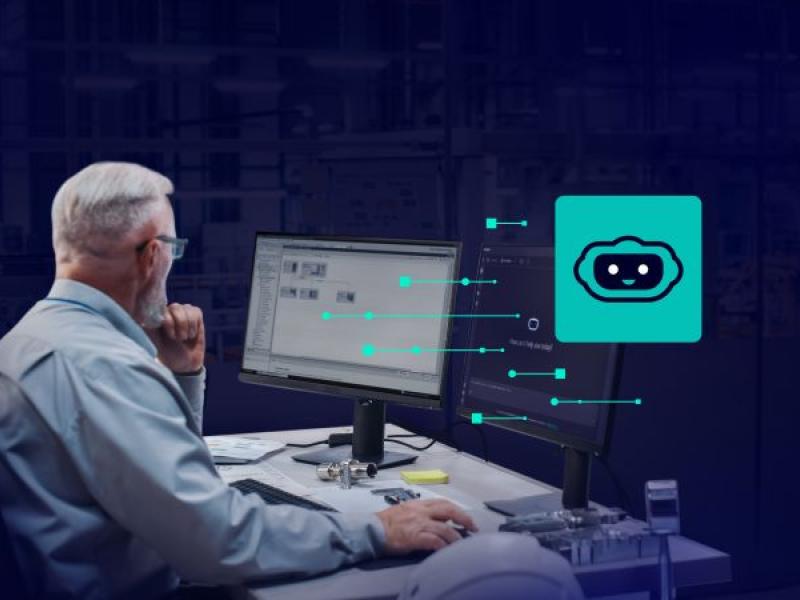
TwinCAT CoAgent is Beckhoff’s intelligent AI assistant, built directly into the engineering environment to make the engineering workflow more efficient. Users interact with it through a standard chat interface, prompting it to perform a wide range of tasks on their behalf. These tasks include anything from reviewing and explaining code to generating new PLC and HMI programs, as well as providing code prompts, documentation or reports. With access to the Beckhoff Infosys knowledge base, CoAgent is deeply familiar with TwinCAT and serves as an ideal coding companion. It saves time, accelerating day-to-day work, and freeing up operators and programmers to focus on more demanding automation tasks.
Looking ahead, Ben believes that most programmers and engineers will soon rely on some form of AI assistance for coding. AI assistants like CoAgent will make development more efficient, intuitive, and focused on problem-solving rather than information hunting. “Asking an AI agent for code examples or implementation guidance will help users understand and apply new libraries and features faster. The days of manually searching through documentation will soon be over. As for maintenance, I can only see this improving in the same way. Searching for bugs or asking for the meaning of errors will all be common practice when problems arise.”
Commenting on the evolution of AI-powered coding agents, Ben notes that as recently as a few months ago, almost all code would need human oversight as mistakes were obvious. Thanks to notable improvements in coding tools, there’s less need for constant human oversight. However, quality checks will remain essential. “My recommendation would be to put these tools in the hands of your programmers and engineers and let them be augmented by it. Write automated tests which can help you to validate your work and keep systems in place to check that code does what it has been designed to do. Repurpose some of the time saved coding into solidifying your quality checks,” he recommends.
Machine learning intelligence
Machine learning is another incredibly powerful tool which can be applied to many different aspects of control system design. Until recently, both the training of models and their integration into the PLC has required specialist expertise. Beckhoff has worked to remove these barriers, making it easy for automation engineers to apply machine learning within their workflow.
The introduction of its TwinCAT Machine Learning solution gives engineers new capabilities that weren’t possible with traditional automation alone. Ben points to the TE3850 Machine Learning Creator as a popular solution, enabling the creation of trained and automated AI models directly from datasets through a simple, user-friendly interface. It automatically generates initial model versions, reduces errors, and accelerates the development process across a range of applications (from classification and forecasting to anomaly detection).
Traditional automation focused is on control and reporting, with algorithms written from first principles. For example, if motor vibration was too high or a product needed rejection for being out of shape, then these actions had to be hand coded. As the complexity of the tasks grew, software development would reach practical limits. “Now, with the integration of Machine Learning in TwinCAT, we can delegate complex assessments to trained models. Functionality which would have once been otherwise impossible, such as detecting complex product anomalies, or programming machines to react to your operator’s hand gestures, all now become achievable and easy to implement,” says Ben.
Machine vision is one technology which will benefit from the developments in machine learning, enabling image classification or final quality assurance of products. “By giving a machine the ability to see, you equip it with the tools to monitor and respond intelligently to its own environment,” adds Ben.
He goes on to say that while machine learning has an important role in modern automation, it isn’t always the optimal solution. “When a problem can be solved through standard, rule-based algorithms, those approaches will generally offer greater speed and reliability. However, as problem complexity increases, so does the value of machine learning, enabling solutions that traditional methods cannot achieve”.
Future outlook
As AI takes on more of the repetitive coding and optimisation tasks, the role of engineers will evolve. Ben reiterates that automation engineers will need to foster diversity of skill and technical knowledge to be comfortable with the variety of new technologies entering the market, and to understand how to optimise the efficiencies enabled by AI. “Domain knowledge and creative skills will become more valuable,” he predicts.
“As a baseline, customers will expect machines to self-optimise and self-diagnose. The features which will differentiate your offering from all the others will be the creative and innovative things you have implemented, which we have not even thought about yet!”
Website: https://www.beckhoff.com/en-au/