
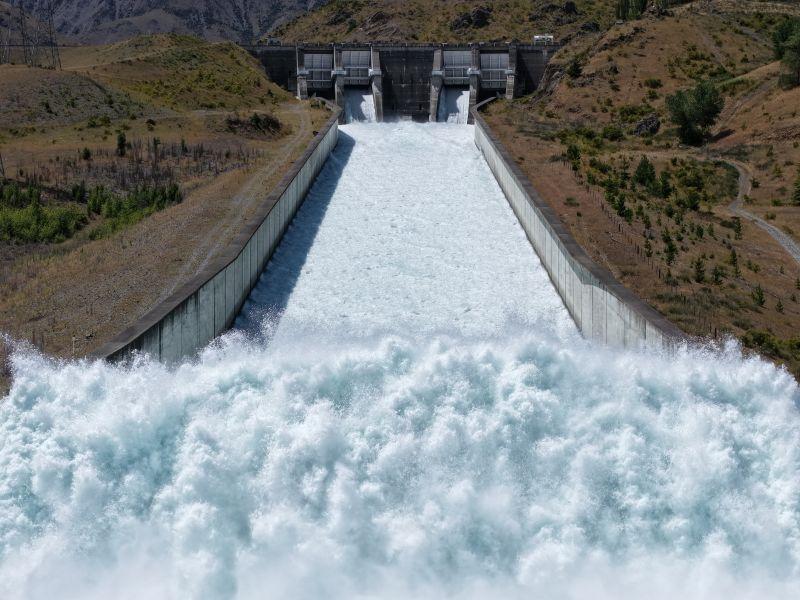
Sixty years after Benmore Power Station first started generating power, Meridian Energy is making seismic improvements to ensure that it will be back up and running as soon as possible if “the big one” hits.
The focus is Benmore’s massive penstocks, which funnel water from the top of the dam down to its turbines.
Unusually, and unlike most dams around the world, Benmore’s penstocks are made of concrete and with the probability of a large earthquake along the South Island’s Alpine Fault growing, it is time to enhance their performance.
“Benmore will be critical to recovering from a large quake as it’s from here that the high voltage DC link runs between the South and North Islands. With Benmore generating enough power for around 300,000 Kiwi homes, the country can’t afford to have it out of action for long,” says Tania Palmer, Meridian GM Generation.
“There’s a 75% chance of a significant earthquake along the Alpine Fault in the next 50 years, so we’re investing now to make sure the penstocks have very little, if any, damage when it does inevitably happen. There’s no risk to the dam itself, but without this work it’s possible that one or more of the six penstocks would be unable to do their job for an extended period of time.”
The seismic strengthening work, being carried out from late 2025 to early 2029, involves modifying the joint at the top of each penstock to allow it to move freely in an earthquake. The project will also install fluid viscous dampers (a form of shock absorber) to dissipate the energy caused during an earthquake and reduce the likelihood of cracks appearing in the penstocks.
The challenge is working on such large pieces of infrastructure without impacting their ability to operate. Each penstock rests on a 37-degree slope and is approximately 130m long, with a 5.3m internal diameter. With the weight of water travelling through them each penstock weighs almost 3000 tonnes, so substantial effort has gone into assessing a suitable engineering solution.
“While this work is not a high risk, we think it’s the first time a project like this has been undertaken anywhere in the world - we’re going to be reinforcing, stabilising and wrapping each penstock all while millions of litres of water are rushing through them,” says Tania Palmer.
“The construction of Benmore was a brilliant piece of Kiwi innovation, so it’s only fitting that the work we’re doing now is equally innovative. Our hydro stations are incredible assets that have served the country well for a long time. We know we’re responsible for helping keep the lights on for Kiwi homes and businesses, and the work we’re doing at Benmore and other stations will help keep them generating clean energy for decades to come.”