
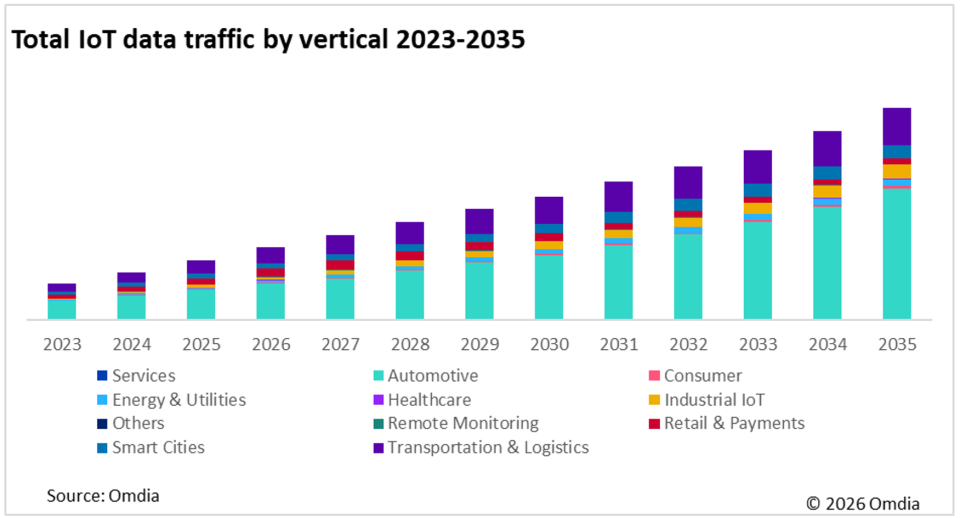
Data traffic from cellular IoT connections is expected to rise to 218.6 exabytes (EB) by 2035, according to Omdia’s latest research. This increase is fueled by a growing demand for data that can be analysed, with the goal of improving operational efficiency and creating new revenue opportunities for businesses.
The research revealed that the majority of cellular IoT data traffic will come from the automotive sector, with key use cases including infotainment services such as video and audio streaming, as well as firmware over-the-air updates. Over the forecast between 2025 to 2035, automotive data traffic will rise from 30.7 EB to 135.4 EB, driven by the integration of infotainment systems in newer vehicles and rising consumer adoption of these services, many of which are expected to rely on 5G connectivity. According to the report, transport and logistics are poised to become the next major sector for cellular IoT data traffic, while all other sectors combined will contribute less than 29% of the total traffic beyond 2025.
Alexander Thompson, Senior Analyst for IoT at Omdia stated, “The rising number of vehicles with smart features, particularly infotainment, will cause cellular IoT data traffic to boom over the next decade. Other video-based use cases will also generate significant amounts of data.”
“While cellular IoT data traffic remains dominated by use cases that require mobility, such as automotive and logistics, emerging trends like remote vision, which enables cameras to be added in a wide range of devices, from delivery robots to industrial machinery, and agentic AI, driving growth in peer-to-peer machine traffic, are increasing demand for greater edge processing power and accelerating 5G adoption. Together, these trends are creating additional data traffic demand that did not exist several years ago," added Andrew Brown, Practice Lead for IoT at Omdia.
The report also emphasises that Asia & Oceania will produce the highest amount of cellular IoT data traffic, comprising 50.6% of global cellular IoT data traffic in 2025. The region has traditionally been an early adopter of new technology and also has a significant number of video cameras installed, which will help drive traffic growth.