
element14's Top Tech Voices podcast continues its second season with two new episodes exploring how neuroscience, AI and health technology are reshaping the way people think, behave and live.
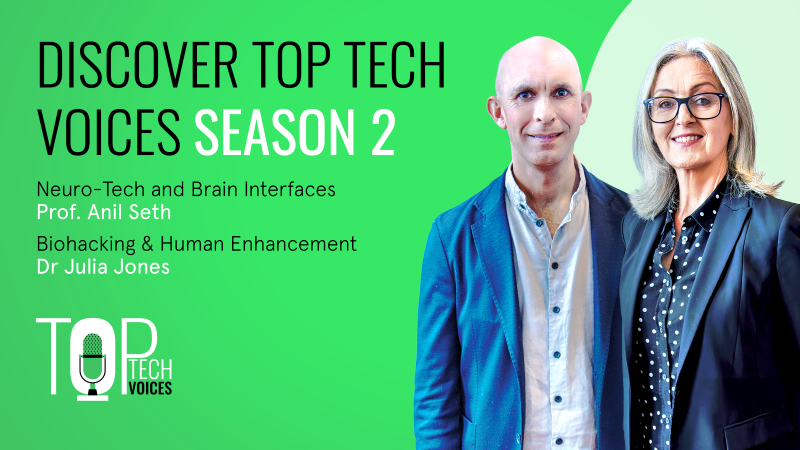
The latest conversations feature renowned neuroscientist and Professor of Cognitive and Computational Neuroscience Anil Seth, and Dr Julia Jones, a neuroscientist, former Olympic psychologist and founder of health‑tech start‑up Validity. Both offer a human-first perspective on the future of innovation.
In episode three, Neuro-tech and Brain Interfaces, Professor Anil Seth explores one of the most profound scientific questions of our time: how the brain creates conscious experience.
Seth describes perception as a “controlled hallucination”, where the brain actively constructs reality by combining predictions with sensory input — challenging the idea of a single, objective experience of the world and explaining why individuals can perceive the same reality in different ways.
The episode also examines the rapid development of brain–computer interfaces (BCIs), which are already transforming treatment for conditions such as epilepsy and paralysis. While acknowledging their potential, Seth raises important ethical questions — particularly around accuracy, misuse and the emerging need to protect “privacy of thought” as neural data becomes more accessible.
Reflecting on artificial intelligence, Seth cautions against designing systems to replicate or replace human thinking. Instead, he advocates for technologies that complement human intelligence, warning that over-standardisation risks creating a “mental monoculture” that diminishes diversity of thought.
The conversation concludes with a call to engineers and technologists to rethink the brain not as a digital machine but as a dynamic, energy-efficient biological system—a shift that could inspire more sustainable, human-centred innovation.
Episode four, Biohacking and Human Enhancement, turns to the future of preventative health, with Dr Julia Jones offers a grounded perspective on how technology can support long-term wellbeing.
Drawing on more than three decades of research, Jones challenges the growing trend of "extreme optimisation" often associated with biohacking. Instead, she advocates for a more sustainable approach focused on extending healthspan — the number of years people live in good health — rather than simply increasing lifespan.
The episode highlights how behaviour change is rooted in neuroscience. Jones explains that forming lasting habits requires consistent repetition over time to physically rewire neural pathways — helping explain why many traditional health interventions fail to deliver lasting results.
She also examines the role of music as a biological tool, drawing on research from elite sport and military environments to demonstrate how sound can regulate mood, enhance performance and support nervous system function — with growing applications in areas such as dementia care. A central theme of the discussion is compassion. Jones argues that modern environments are often misaligned with human biology and that shifting from blame to understanding can significantly improve health outcomes.
Looking ahead, she outlines a vision for health technology that combines data with human connection — using AI to support coaches, personalise interventions and scale engagement, while preserving the accountability and empathy that drive real behavioural change.
"As technology becomes more embedded in how we think, work and live, innovation must remain grounded in human needs," said Rebeca Obregon, President of element14. "These conversations highlight an important shift — from building technology for efficiency alone, to designing systems that support how people actually think, behave and stay healthy. Whether it's AI or health technology, the opportunity lies in using innovation to enhance human potential."
The latest episodes of Top Tech Voices are now available to stream, continuing the series' focus on human-centred innovation across AI, health and emerging technologies.
Further episodes will be released in the coming weeks. Listeners can subscribe for updates via element14's YouTube channel or Spotify.