
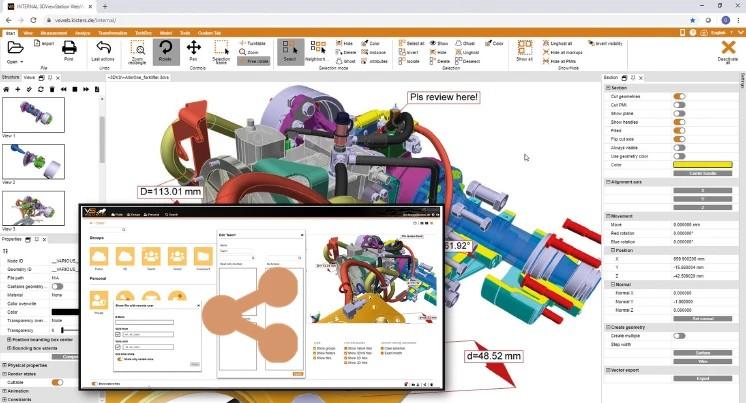
Communication between OEMs and suppliers—such as mould and die manufacturers—is now a critical factor in ensuring fast development and procurement processes. At the same time, the complexity of products, assemblies, and supply chains is continuously increasing. Technical inquiries, file exchanges, change management, and reviews often result in significant effort and delays. Modern visualisation technologies offer new possibilities in this area. With KISTERS 3DViewStation, companies can securely share, analyse, and annotate 3D and 2D CAD data across organisational boundaries—without native CAD systems, without data conversion, and without having to disclose sensitive design data.
Faster quoting processes through direct access to geometry data
A typical scenario in the manufacturing industry: An OEM wants to request quotes for plastic parts, casting parts, or complex components. For this, mould and die makers need to analyse the part geometry and assess the manufacturing effort. Instead of sending 3D files to multiple suppliers via email or data exchange platforms, the OEM makes the model available for online access through portal solutions such as VisShare. If necessary, different user permissions can be set up. The requested suppliers can view, analyse, measure, evaluate, and comment on the part right in their browser using the integrated KISTERS 3DViewStation WebViewer. They check draft angles, measure wall thicknesses, perform collision analyses, check for undercuts, and evaluate mold complexity. The OEM retains control over its design data, as no CAD models are downloaded. The result is leaner Request-for-Quotation (RFQ) processes and less uncontrolled data copies.
Addressing questions directly and interactively on the model eliminates lengthy review cycles
In many quotation processes, questions arise—for example, regarding radii, parting lines, or manufacturing tolerances. Typically, this involves taking screenshots, annotating PDF documents, writing emails, or scheduling meetings. With 3DViewStation, suppliers can add comments and markings directly to the relevant geometric areas in the 3D model. Design, purchasing, and suppliers all work on the same visual basis. This helps prevent misunderstandings, shortens coordination cycles, and speeds up decision-making.
Faster evaluation of design changes
It becomes particularly time-consuming when components change during an ongoing inquiry. For example, if the OEM modifies rib structures, wall thicknesses, or demoulding directions, suppliers often need to manually check what impact this has on mould costs and manufacturing expenses. By comparing geometric versions using special functions in 3DViewStation, changes can be quickly identified. Mold makers immediately recognize which areas are affected and can adjust their cost estimates accordingly. As a result, quotes are available faster and rarely need to be completely redone.
Similar components instead of new designs
There is also significant potential for cost savings internally. Many companies have thousands of existing components that are often developed or procured multiple times simply because they cannot be found. Through geometry-based similarity searches—which can be individually implemented into a leading system—engineering and procurement teams can identify existing components based on their shape. For instance, a buyer can check whether a similar housing, bracket, or cast part already exists within the company before initiating a new request. This reduces the number of variants, prevents duplicate development efforts, and lowers procurement costs.
Making CAD Data useable in the parts catalogue
Digital parts catalogues also benefit from integrated 3D visualisation. With just a few clicks, employees can visually identify components and their corresponding part numbers in the CAD model, allowing them to check stock levels and place orders. This reduces search times, minimises incorrect orders, and cuts down on back-and-forth communication between sales, service, purchasing, and customers—especially in the spare parts business or when dealing with variant products.