
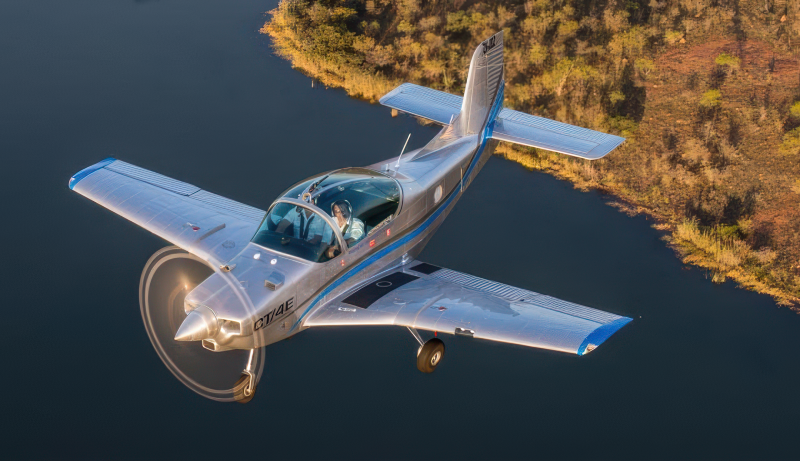
NZ's largest commercial aircraft manufacturer is restarting production of one of the country’s most successful aircraft exports after a 14-year hiatus, as growing global demand for military and civilian pilot training creates an opportunity for the country to secure a larger share of the international aviation market.
The move comes as His Excellency Anutin Charnvirakul, Prime Minister of the Kingdom of Thailand, leads an official visit to New Zealand. At Ardmore Airport on Friday, 21 August, Prime Minister Charnvirakul and New Zealand Prime Minister Rt Hon Christopher Luxon witnessed the signing of a new Memorandum of Understanding with Waikato-based manufacturer NZAero, and attended demonstrations of the company’s CT-4 Airtrainer and 750XL, as well as a showcase of its E-350 Expedition.
The new agreement strengthens a decades-long aviation relationship with Thailand and could represent tens of millions of dollars of export revenue for NZAero over the next three years.
Prime Minister Christopher Luxon says the agreement reflects the growing depth of New Zealand’s relationship with Thailand and the opportunities this is creating for Kiwi exporters.
“New Zealand and Thailand have a strong and longstanding relationship, and as we mark 70 years of diplomatic ties there is a real opportunity to translate that relationship into greater trade, investment and defence cooperation.
“New Zealand has world-class advanced manufacturing and aerospace capability, and this is exactly the kind of high-value sector where we want to see Kiwi businesses competing and succeeding internationally,” he says.
NZAero has begun building five new CT-4 Airtrainers, the first new aircraft of the type to enter production since 2012, following growing interest from both military and civilian pilot training organisations.
The company is also investigating opportunities to work with Kiwi tech firms to use AI to analyse flight and cockpit data generated by the new-generation aircraft, creating a more advanced training system that can identify safety risks and improve pilot performance.
NZAero CEO Stephen Burrows says flight training organisations face growing demand as the aviation sector works to train the next generation of commercial pilots.
Boeing forecasts the global commercial aviation industry will require 674,000 new pilots over the next 20 years, with Southeast Asia alone previously forecast to require around 62,000 new commercial pilots through 2044.
Burrows says this will increase demand for specialist training aircraft needed to develop pilots before they progress onto more sophisticated platforms.
“The CT-4 occupies a specialist position at the introductory end of the pilot training pathway, providing trainees with an aircraft on which to develop core flying skills before progressing to significantly faster and more technologically complex aircraft”.
Burrows says the combination of expanding pilot demand, a limited number of competing aircraft in the category and new technology being incorporated into the CT-4 creates an opportunity for New Zealand to secure international market share.
“There are only a small number of aircraft which compete directly in this category and the competing designs are also relatively old.
“What we have is a proven aircraft which is now being brought back into production with a modern glass cockpit, flight data capture and significant safety and performance improvements.
“We are seeing growing interest internationally from civilian operators involved in airline pilot training as well.
“The CT-4 provides that important first step in a pilot’s development. It allows trainees to establish core flying skills in an aircraft that is straightforward and forgiving to operate before progressively introducing the speed, technology and complexity of more advanced platforms.
“With particularly strong aviation growth forecast across our region, we believe there is a real opportunity for New Zealand to capture a larger share of this international market,” he says.
The agreement builds on NZAero’s existing relationship with Thailand, where the CT-4 has been used to train generations of military pilots.
An estimated 3,500 Thai pilots have undergone basic flight training on the CT-4 at least once since the aircraft was introduced into service in Thailand in 1973.
The new MOU is expected to broaden aviation cooperation between New Zealand and Thailand across areas including maintenance and sustainment expertise, personnel development and training, technical support, knowledge sharing and long-term planning for spare parts and engines.
“The agreement is an important endorsement of what our team in New Zealand has been able to deliver and provides a platform for us to deepen our aviation relationship with Thailand,” Burrows says.
The Royal Thai Air Force currently operates 25 CT-4 aircraft, including 19 CT-4Es which NZAero is in discussions to modernise.
Thailand’s training model sees pilots progress from the CT-4 through increasingly sophisticated aircraft, allowing them to build core aircraft-handling skills before moving onto advanced military platforms.
The proposed Thai modernisation programme would replace ageing instrumentation with modern electronic avionics and incorporate a range of safety, reliability and performance enhancements.
The programme remains subject to Thai Government budget approval. If approved, Burrows says the resulting work could lift Thailand from around 10% of NZAero’s business currently to approximately 20% within the next year.
NZAero currently has 10 positions being advertised across areas including quality, safety and logistics, with some of the additional capability being developed to support its growing Thai exports.
Increasing international interest has also prompted the company to restart CT-4 production without confirmed buyers for the first five aircraft.
Burrows says the civilian opportunity is being driven in part by demand for upset prevention and recovery training, known as UPRT, which teaches pilots how to recognise and recover from unusual aircraft attitudes and loss-of-control situations.
Many aerobatic aircraft traditionally used for this training have tailwheel configurations which can be more demanding for inexperienced pilots.
The CT-4 uses a tricycle undercarriage and side-by-side seating configuration, allowing an instructor and trainee to operate alongside each other and making the aircraft more accessible earlier in a pilot’s training.
“The civilian market is particularly interesting because there is a shortage of suitable aircraft for this type of training globally.
“The same characteristics which have made the CT-4 successful as a military trainer for more than half a century also make it relevant to a new generation of commercial pilots,” Burrows says.
The new version will retain the proven airframe but introduce recording technology that can capture aircraft position, engine parameters, avionics information and video during a training flight, with data able to be transmitted back to base for instructors to review.
Burrows says AI could add another layer to this information by helping identify patterns that improve training outcomes and safety.
“The technology gives instructors access to significantly more information about each training flight. If AI can be used to interrogate that data, there is potential to identify areas where pilot training and safety can be improved.
“There are New Zealand tech companies already working in areas such as synthetic training and data capture, so we are investigating how that local capability could be combined with the aircraft to create a wider New Zealand-developed aviation training solution,” he says.
This year also marks the 70th anniversary of diplomatic relations between New Zealand and Thailand, while approximately 70 New Zealand-manufactured aircraft have been exported to Thailand during that period, including Air Tourers, CT-4s, Fletcher aircraft and 750XLs.