

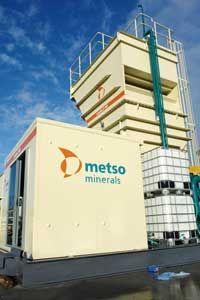
MIMICO’s new Lamella clarifier/thickener is the first truly portable water treatment system designed specifically for quarries and construction sites which offers the proven, environmentally sound Lamella treatment process; is fully transportable; and can be assembled and operational in three to four hours. The system also offers an automated polymer mixing option and water recycling options. There is no operator requirement (full automation option for remote sites), and monitoring or managing of the plant’s performance can be from anywhere in New Zealand. There’re options to purchase or lease and models to treat from 30 to 800 cubic metres per hour. For example, the LT-100 model will process up to 100 cubic metres of contaminated water per hour. This model is transported in three units by truck and quickly assembled on site. Despite its impressive processing capacity, the plant’s footprint is just six metres by six metres. Here’s how it works. A Metso VT pump is used to deliver contaminated water into the Lamella. Polymer is added to produce larger particles called flocs. The flocs make their way through feed ports into the Lamella plate packs which, because of their unique design, cause the flocs to settle quickly to the bottom of the thickener. Clean water then moves up through the Lamella plates, and overflows through the discharge launder. The clean water is then piped into a tank, and can be reused around the site by means of a recycle pump. Solids are allowed to consolidate into a thickened sludge. The density of the sludge is monitored and discharged at regular intervals. This proven system can be used in even the most sensitive of environments. The transportable Lamella clarifier/thickener has been completely redesigned and re-engineered by Mimico to meet industry requirements and environmental standards. Modern M2M (machine to machine) technology options can deliver specific information on the plant’s operation to operators and managers. Data can be sent in a text message to a cell phone or emailed as a regular detailed report. Data is also logged on the plant operator’s screen and can be viewed in real time. The plant’s modern touch screen is easy to use and allows the operator to oversee the operation quickly and simply.• reader enquiries quote: D090120
Portable water treatment for quarries and construction sites
General
Wednesday, 14 January 2009
Related Articles
Wednesday, 14 October 2026
From an ‘insect nose on a chip’ and space technology to breakthrough cleantech and agri-innovation, the winners of the 2026 KiwiNet Research Commercialisation Awards showcase extraordinary science-...
Wednesday, 14 October 2026
Years spent gaming may be giving some young New Zealanders an unexpected head start in the modern trades, as automation, robotics and digital technology transform traditional workplaces.
Industry...
Wednesday, 07 October 2026
A new aviation engineering training initiative designed to help address a chronic shortage of hundreds of aircraft engineers is set to launch in Hamilton, as industry leaders warn the growing skills...